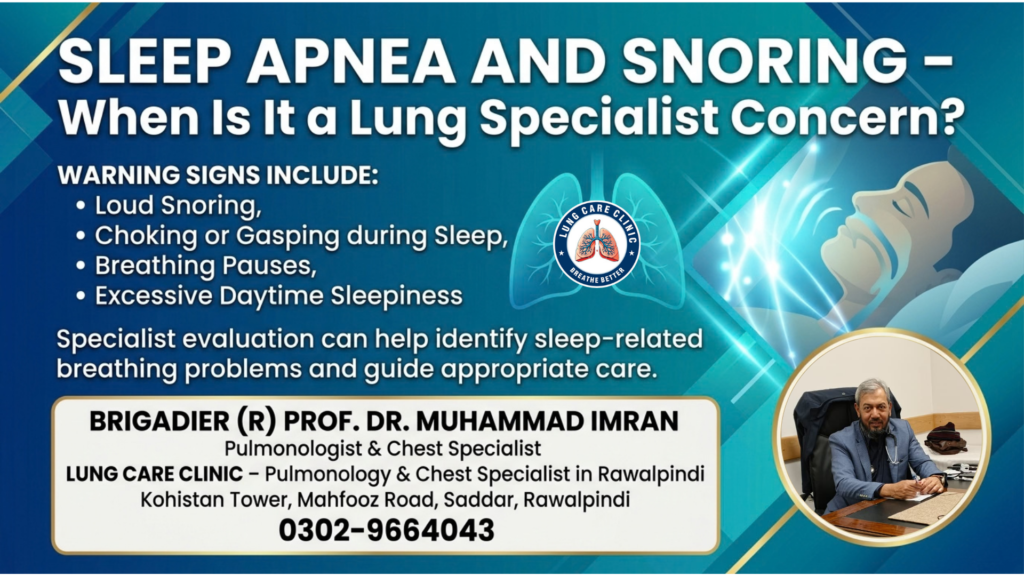
Snoring is common, but loud or persistent snoring can sometimes be more than a nighttime nuisance. Sleep apnea is a sleep-related breathing disorder in which breathing repeatedly becomes reduced or stops during sleep. These interruptions can disturb sleep quality and may cause symptoms such as choking or gasping during sleep, morning headaches, poor concentration, and excessive daytime sleepiness.
If you or someone in your family notices loud snoring, breathing pauses, or repeated choking during sleep, it is worth discussing these symptoms with a healthcare professional. A pulmonologist or sleep specialist can assess whether an underlying breathing disorder may be contributing to the problem.
What Is Sleep Apnea?
Sleep apnea is a condition in which normal breathing is repeatedly interrupted during sleep. The most common type is obstructive sleep apnea, which occurs when the upper airway becomes narrowed or blocked during sleep.
When the airway becomes restricted, airflow can decrease or stop temporarily. The brain may then briefly increase the body’s effort to breathe, causing the person to partially awaken or change their breathing pattern. These episodes can occur repeatedly throughout the night.
Because many people do not remember waking up, they may not realize that their sleep is being repeatedly disturbed.
Sleep apnea can affect adults of different ages. However, the likelihood may increase with certain factors, including excess body weight, certain airway or facial structures, alcohol use, smoking, and a family history of sleep apnea.
Is Snoring Always a Sign of Sleep Apnea?
No. Snoring does not automatically mean that a person has sleep apnea.
Simple snoring can occur when air passes through a narrowed upper airway and causes surrounding tissues to vibrate. Some people snore without having significant breathing interruptions.
However, certain patterns of snoring deserve greater attention.
Loud, frequent snoring accompanied by breathing pauses, choking, gasping, restless sleep, or significant daytime sleepiness can raise concern for obstructive sleep apnea.
Therefore, the important question is not simply whether someone snores. It is whether the snoring occurs together with other symptoms of disturbed breathing during sleep.
Snoring and Choking in Sleep: A Warning Sign
One of the more concerning symptoms is waking up choking, gasping, or struggling to breathe.
A person with sleep apnea may partially wake when the airway becomes significantly restricted. They may suddenly gasp for air, take a deep breath, or briefly awaken before returning to sleep.
A bed partner may notice these episodes before the affected person does.
Warning signs can include:
- Loud or persistent snoring
- Choking or gasping during sleep
- Witnessed pauses in breathing
- Restless or fragmented sleep
- Waking with a dry mouth
- Morning headaches
- Feeling unrefreshed after sleeping
- Excessive daytime sleepiness
- Difficulty concentrating
- Irritability or mood changes
These symptoms do not prove that a person has sleep apnea. However, when several occur together, medical assessment is appropriate.
Can Sleep Apnea Cause Daytime Sleepiness?
Yes. Excessive daytime sleepiness is an important symptom associated with sleep apnea.
Repeated breathing disturbances can fragment normal sleep. Even when a person appears to sleep for several hours, their sleep may not provide the restorative quality needed for normal daytime functioning.
As a result, someone may feel tired or sleepy during the day.
They may struggle to concentrate at work, feel less alert while driving, or find themselves becoming sleepy during quiet activities such as reading or watching television.
Persistent daytime sleepiness should not simply be attributed to a busy lifestyle or insufficient sleep without considering other possible causes. Poor sleep habits, medications, mental health conditions, anemia, thyroid disorders, and other medical problems can also contribute to fatigue or sleepiness.
A specialist evaluation can help determine whether sleep apnea or another condition may be responsible.
Why Can a Pulmonologist Be Involved in Sleep Apnea?
Sleep apnea is primarily a sleep-related breathing disorder, but the condition directly involves breathing during sleep. For this reason, pulmonologists with appropriate sleep-medicine experience may evaluate patients with suspected sleep apnea.
A respiratory specialist can review symptoms, medical history, risk factors, and breathing concerns. Depending on the situation, further assessment may include a sleep study or other investigations.
A pulmonologist may also be particularly relevant when sleep-related breathing problems occur alongside conditions such as asthma, COPD, chronic respiratory disease, or unexplained nighttime breathing difficulties.
The appropriate specialist can vary depending on the patient’s symptoms and suspected cause.
When Should You See a Sleep Apnea Doctor?
Consider seeking medical evaluation if you experience persistent or significant symptoms such as:
- Very loud or frequent snoring
- Choking or gasping while asleep
- Someone notices that you stop breathing during sleep
- Significant daytime sleepiness
- Repeated nighttime awakenings
- Morning headaches
- Poor concentration
- Persistent fatigue despite adequate sleep
- Waking with a sensation of insufficient air
- Sleep-related breathing problems that are affecting daily life
It is particularly important to seek professional advice if daytime sleepiness affects driving, work performance, or other activities that require alertness.
How Is Sleep Apnea Diagnosed?
A diagnosis cannot be made from snoring alone.
A healthcare professional will usually begin by discussing symptoms, sleep patterns, medical history, medications, lifestyle factors, and other relevant risks.
A sleep study may then be recommended when sleep apnea is suspected.
Depending on the patient’s situation, testing may be performed in a sleep center or, for selected patients, through an appropriate home sleep apnea test.
A sleep study can monitor several factors during sleep, which may include breathing patterns, oxygen levels, heart rate, and other measurements. The results help determine whether repeated breathing disturbances are occurring and how significant they may be.
The appropriate test depends on the patient’s symptoms and medical circumstances.
What Happens If Sleep Apnea Is Left Untreated?
Untreated sleep apnea can affect sleep quality, daytime alertness, and overall health.
Repeated nighttime breathing disturbances may contribute to excessive daytime sleepiness and impaired concentration. Over time, obstructive sleep apnea is also associated with cardiovascular and metabolic health problems.
This does not mean that every person who snores will develop complications. It means that persistent symptoms should be properly assessed rather than ignored.
Early evaluation can help determine whether sleep apnea is present and whether treatment is needed.
Sleep Apnea Treatment Options
Treatment depends on the type and severity of sleep apnea, symptoms, medical history, and individual circumstances.
For obstructive sleep apnea, management may include lifestyle measures, positive airway pressure therapy, oral appliances, positional strategies, or other treatments when appropriate.
CPAP Therapy
Continuous positive airway pressure, commonly known as CPAP, is an established treatment for obstructive sleep apnea.
The device delivers a controlled flow of air through a mask to help keep the upper airway open during sleep.
CPAP can be highly effective when appropriately prescribed and used consistently.
However, treatment should be individualized. A healthcare professional can help determine whether CPAP is appropriate and provide guidance on proper use.
Lifestyle and Weight Management
For people who are overweight or obese, appropriate weight management may help reduce the severity of obstructive sleep apnea.
Other lifestyle measures may also be recommended depending on the individual’s situation.
These can include avoiding excessive alcohol, maintaining regular sleep habits, and following advice about sleeping position.
Lifestyle measures should not be considered a substitute for medical evaluation when significant symptoms are present.
Oral Appliances
Some patients with obstructive sleep apnea may benefit from specially designed oral appliances that help maintain airway patency during sleep.
These devices are not appropriate for everyone. Their suitability depends on the type and severity of sleep apnea and individual factors.
Can Sleep Apnea Cause Breathlessness?
Sleep apnea can cause nighttime breathing disturbances, including gasping or choking episodes. Some people may describe these episodes as waking up unable to catch their breath.
However, breathlessness has many possible causes.
Asthma, COPD, respiratory infections, heart conditions, anemia, anxiety, deconditioning, and other medical problems can cause shortness of breath.
Therefore, persistent breathlessness should not automatically be diagnosed as sleep apnea.
If breathing difficulty occurs during the day, with physical activity, or while awake at rest, a broader medical assessment may be needed.
Sleep Apnea in Rawalpindi and Islamabad
People searching for a sleep apnea doctor in Rawalpindi may begin with symptoms such as snoring, daytime sleepiness, nighttime choking, or unexplained sleep disturbance.
Local evaluation can be particularly useful when symptoms are persistent and are affecting daily life.
At Lung Care Clinic in Saddar, Rawalpindi, patients can seek specialist respiratory evaluation for breathing-related concerns. The assessment can help determine whether symptoms may be related to sleep apnea or another respiratory condition.
Patients should provide as much information as possible about their sleep symptoms. If a family member or partner has observed breathing pauses, choking, gasping, or unusually loud snoring, that information can be helpful during the consultation.
What Information Should You Take to Your Appointment?
Before seeing a specialist, it can help to note:
- How often you snore
- Whether snoring is loud or persistent
- Whether someone has noticed breathing pauses
- Whether you wake up choking or gasping
- How sleepy you feel during the day
- Whether you wake with headaches or a dry mouth
- Your usual sleep schedule
- Any medications you take
- Existing lung or heart conditions
- Any previous sleep testing
A bed partner’s observations can sometimes provide useful information because the affected person may not be aware of nighttime breathing interruptions.
When Snoring Needs Specialist Attention
Occasional snoring may not indicate a serious medical problem. However, persistent loud snoring combined with choking, gasping, witnessed breathing pauses, or significant daytime sleepiness deserves attention.
The goal of evaluation is not simply to stop snoring. It is to determine whether an underlying sleep-related breathing disorder is present.
If sleep apnea is confirmed, appropriate treatment can help improve sleep quality and daytime alertness and may reduce health risks associated with untreated disease.
Consult a Pulmonologist for Sleep-Related Breathing Problems
Sleep apnea can be easy to overlook because the main symptoms occur while a person is asleep.
If you regularly snore loudly, wake up choking or gasping, experience breathing pauses during sleep, or feel unusually sleepy during the day, consider discussing these symptoms with a qualified healthcare professional.
At Lung Care Clinic, Brigadier (R) Prof. Dr. Muhammad Imran, Pulmonologist & Chest Specialist, provides specialist respiratory evaluation for patients with breathing-related concerns.
Brigadier (R) Prof. Dr. Muhammad Imran
Pulmonologist & Chest Specialist
Kohistan Tower, Mahfooz Road, Military Hospital Rd, Opposite AFIC, Saddar, Rawalpindi
0302-9664043