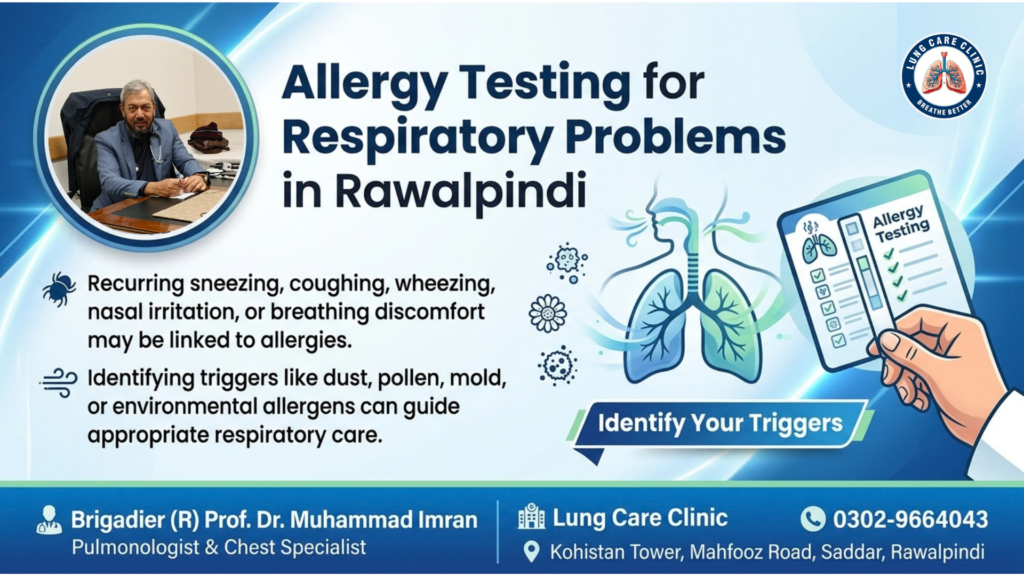
Recurring sneezing, coughing, wheezing, nasal irritation, and breathing discomfort can sometimes be related to allergies. However, respiratory symptoms do not always have a single cause. Dust, pollen, mold, animal allergens, air pollution, infections, asthma, and other conditions can produce similar complaints. Allergy testing in Rawalpindi can help identify specific allergens that may be contributing to a person’s symptoms and support a more targeted evaluation.
For people who experience repeated respiratory symptoms, understanding possible triggers is an important part of long-term care. A respiratory specialist can assess the symptoms, medical history, environmental exposures, and relevant test results before recommending an appropriate management plan.
What Is Allergy Testing?
Allergy testing is used to help determine whether a person has an allergic sensitivity to particular substances, known as allergens.
Common allergens associated with respiratory symptoms include:
- House dust mites
- Pollen
- Mold spores
- Animal dander
- Certain environmental particles
- Some occupational allergens
Testing does not simply determine whether someone has “an allergy.” Instead, the appropriate test can help identify specific substances to which the immune system may react.
The choice of test depends on the person’s symptoms, medical history, age, medications, and suspected triggers.
Why Consider Allergy Testing for Respiratory Problems?
Allergies can affect the nose, sinuses, throat, and lower airways. In some people, exposure to an allergen may trigger symptoms such as sneezing, nasal congestion, coughing, wheezing, or breathing difficulty.
Allergic inflammation can also be associated with asthma in susceptible individuals.
For example, someone may notice that coughing or wheezing becomes worse after cleaning a dusty room. Another person may experience symptoms during a particular pollen season. Someone else may notice breathing problems around pets or in a damp environment where mold may be present.
Identifying these patterns can be useful, but symptoms alone cannot always confirm an allergy.
This is where appropriate clinical assessment and, when indicated, allergy testing can provide additional information.
Common Symptoms That May Be Associated With Respiratory Allergies
Respiratory allergy symptoms vary depending on the allergen and the individual.
Possible symptoms include:
- Frequent sneezing
- Runny or blocked nose
- Itchy nose
- Watery or itchy eyes
- Post-nasal drainage
- Recurrent coughing
- Throat irritation
- Wheezing
- Chest tightness
- Shortness of breath
- Symptoms that worsen in dusty environments
Some people experience mainly upper-airway symptoms, while others may have lower-airway symptoms or asthma-related complaints.
Persistent breathing symptoms should not automatically be attributed to allergies. A specialist may need to consider asthma, COPD, respiratory infections, reflux, sinus disease, or other conditions.
Dust Allergy and Breathing Problems
Dust is a common concern for people experiencing respiratory symptoms.
House dust can contain multiple components, including dust-mite particles, fibers, animal material, and other substances. Dust mites are particularly relevant to allergic disease in susceptible individuals.
A person may notice symptoms when cleaning, sweeping, changing bedding, handling carpets, or spending time in dusty environments.
Possible symptoms include sneezing, nasal congestion, coughing, wheezing, and breathing discomfort.
However, not every reaction to dust is an allergy. Dust can also irritate the airways without causing an allergic immune response.
Therefore, a detailed history can help distinguish possible allergic symptoms from general airway irritation.
What Is a Skin Prick Allergy Test?
A skin-prick test is one method used to assess sensitivity to selected allergens.
During testing, small amounts of suspected allergens are introduced into the superficial skin, commonly on the forearm or back. The skin is then observed for a localized reaction.
A positive test can indicate sensitization to that allergen. However, sensitization does not always mean that the allergen is responsible for a person’s symptoms.
This is why test results should be interpreted together with the patient’s medical history and symptom pattern.
Skin testing should be performed and interpreted by appropriately trained healthcare professionals, particularly when there is a history of significant allergic reactions.
What Is an IgE Blood Test?
Blood testing can also be used to assess allergen-specific IgE antibodies.
This may be considered when skin testing is unsuitable or when a clinician wants additional information about specific suspected allergens.
Blood tests can be useful in selected situations, but they also have limitations. A positive result does not automatically prove that an allergen causes a person’s symptoms.
Likewise, test results should not be interpreted in isolation.
The appropriate testing method depends on the individual patient and the clinical question being investigated.
Allergy Testing and Asthma
Allergies and asthma can be connected, particularly in people with allergic asthma.
Exposure to allergens such as dust mites, pollen, mold, or animal dander may trigger asthma symptoms in susceptible individuals.
These symptoms can include:
- Wheezing
- Coughing
- Chest tightness
- Shortness of breath
If someone has both suspected allergies and recurring breathing problems, evaluation may involve more than allergy testing.
A respiratory specialist may also consider lung-function testing, such as spirometry, depending on the symptoms.
The purpose is to understand whether airway narrowing or asthma is contributing to the breathing problem.
Does a Positive Allergy Test Mean You Have an Allergy?
Not necessarily.
This is an important point when interpreting allergy test results.
A positive test can indicate sensitization, meaning the immune system has antibodies or a response associated with a particular allergen. However, the person may not experience symptoms whenever exposed to that substance.
For this reason, a clinician considers:
- The patient’s symptoms
- Timing of symptoms
- Exposure history
- Test results
- Medical history
- Other possible causes
This approach helps avoid unnecessary elimination of foods, environmental restrictions, or treatments based solely on a laboratory result.
When Should You Consider Allergy Testing?
Allergy testing may be considered when respiratory or nasal symptoms repeatedly occur in connection with suspected environmental exposures.
Examples include symptoms that:
- Recur around dust
- Become worse during pollen seasons
- Occur around pets
- Increase in damp or mold-prone environments
- Appear during specific workplace exposures
- Accompany recurrent wheezing or asthma symptoms
- Continue despite routine symptom management
Testing is not necessarily required for every person with sneezing or coughing.
A healthcare professional can determine whether testing is appropriate after reviewing the individual’s symptoms and history.
Preparing for Allergy Testing
Preparation depends on the type of allergy test being performed.
Some medications, particularly certain antihistamines, can affect the results of skin testing. Patients should therefore tell their healthcare provider about all medicines they are taking.
Do not stop prescribed medication on your own simply because you are planning an allergy test.
The healthcare professional can provide specific instructions about whether any medication needs to be temporarily adjusted.
What Happens After Allergy Testing?
The next step depends on the test results and the patient’s symptoms.
If a clinically relevant allergen is identified, the healthcare professional may recommend strategies to reduce exposure.
For example, dust-sensitive individuals may benefit from practical measures to reduce indoor allergen exposure. People with pollen-related symptoms may be advised about environmental precautions during periods of high exposure.
If asthma is also present, the management plan may include appropriate asthma treatment.
In some cases, further evaluation may be necessary because allergy testing does not explain all respiratory symptoms.
Allergy Testing Does Not Replace Respiratory Evaluation
A person may have breathing symptoms even when allergy testing does not identify a significant allergic trigger.
This can happen because respiratory symptoms have many possible causes.
For example, wheezing can occur with asthma, respiratory infections, COPD, or other airway problems. Chronic cough can be related to asthma, post-nasal drainage, reflux, medication effects, infections, or other conditions.
Similarly, shortness of breath can have pulmonary, cardiac, blood-related, or other causes.
Therefore, allergy testing should be considered as part of an appropriate clinical evaluation when indicated, rather than as a universal test for every breathing complaint.
Allergy Testing in Rawalpindi
People looking for allergy testing in Rawalpindi may have different concerns, ranging from dust sensitivity and seasonal allergies to recurrent cough, wheezing, or asthma symptoms.
At Lung Care Clinic in Saddar, Rawalpindi, respiratory symptoms can be assessed by Brigadier (R) Prof. Dr. Muhammad Imran, Pulmonologist & Chest Specialist.
A consultation can help determine whether symptoms may be related to allergies, asthma, airway disease, environmental exposure, or another respiratory condition.
Where clinically appropriate, further testing can be considered based on the individual’s symptoms and medical history.
The goal is to identify the likely cause of respiratory symptoms rather than relying on a single test without context.
Managing Dust and Environmental Triggers
Reducing exposure to suspected allergens may help some people manage symptoms.
Practical measures can include:
- Keeping sleeping areas clean
- Washing bedding regularly
- Reducing dust accumulation
- Cleaning surfaces appropriately
- Addressing visible mold or dampness
- Improving indoor ventilation where appropriate
- Avoiding tobacco smoke
- Reducing exposure to known personal triggers
The exact strategy depends on the suspected allergen.
It is also important to remember that excessive cleaning chemicals, strong fragrances, smoke, and other irritants can affect sensitive airways even when they are not allergens.
When to See a Respiratory Specialist
Consider specialist evaluation if you experience recurring:
- Wheezing
- Chest tightness
- Shortness of breath
- Persistent cough
- Nighttime breathing symptoms
- Breathing problems around dust or other suspected triggers
- Recurrent asthma-like symptoms
- Respiratory symptoms that interfere with daily activities
A pulmonologist can help determine whether the symptoms are consistent with asthma, allergy-related airway problems, another respiratory condition, or a combination of factors.
When Breathing Symptoms Need Urgent Care
Allergy symptoms are often mild, but serious reactions can occur.
Seek urgent medical attention if breathing difficulty becomes severe, especially when accompanied by swelling of the lips or tongue, difficulty speaking, fainting, confusion, bluish discoloration, or rapidly worsening symptoms.
Severe breathing difficulty should never be assumed to be a simple dust allergy.
Allergy testing can be useful when recurring respiratory symptoms appear to be associated with specific environmental triggers. Dust mites, pollen, mold, and animal allergens are among the substances that may be relevant to people with allergic respiratory conditions.
However, a positive allergy test does not automatically establish that an allergen is responsible for every symptom. Test results should be interpreted alongside the patient’s history, symptoms, and clinical examination.
For people experiencing recurrent coughing, wheezing, chest tightness, sneezing, or breathing discomfort, an appropriate respiratory evaluation can help identify the possible cause and guide further testing or management.
If you are looking for allergy testing in Rawalpindi because of recurring respiratory symptoms, discuss your concerns with a qualified respiratory specialist before starting treatment or making major changes to your environment.
Brigadier (R) Prof. Dr. Muhammad Imran
Pulmonologist & Chest Specialist
Lung Care Clinic
Kohistan Tower, Mahfooz Road, Saddar, Rawalpindi
0302-9664043