Waking up exhausted despite spending eight hours in bed is often more than simple fatigue. Repeated breathing pauses during sleep disrupt deep rest and strain the cardiovascular system. Seeking a thorough sleep apnea diagnosis in Rawalpindi helps patients identify nocturnal airway obstruction early and protect long-term heart and lung health.
Many individuals assume loud snoring is harmless. In reality, chronic snoring paired with gasping, morning headaches, or daytime drowsiness signals sleep-disordered breathing. Understanding how a pulmonologist evaluates sleep apnea and guides patients through diagnostic testing removes uncertainty and leads to effective respiratory care.
Understanding Sleep Apnea Diagnosis in Rawalpindi
Sleep apnea is a medical condition characterized by repeated interruptions in normal breathing throughout the night. Each pause can last from ten seconds to over a minute, causing blood oxygen levels to drop and forcing the brain to trigger brief micro-awakenings to reopen the airway.
Because these awakenings last only a few seconds, most patients do not remember waking up. However, repeated oxygen drops place continuous stress on the heart, blood vessels, and lungs.
Types of Sleep Apnea
- Obstructive Sleep Apnea (OSA): The most common form, occurring when relaxed throat muscles and soft tissues temporarily block the upper airway during sleep.
- Central Sleep Apnea (CSA): Occurs when the brain temporarily fails to send consistent signals to the muscles that control breathing.
- Complex Sleep Apnea Syndrome: Combines features of both upper airway obstruction and central breathing control pauses.
Common Symptoms That Warrant a Sleep Apnea Evaluation
Because breathing pauses happen while you are asleep, bed partners or family members often notice the earliest warning signs.
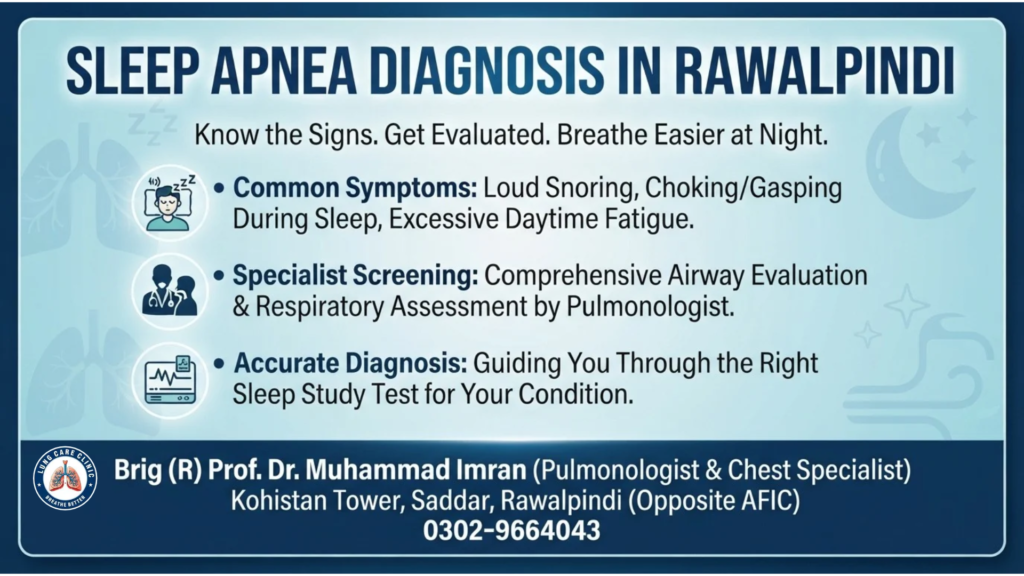
Consulting a specialist for sleep apnea diagnosis in Rawalpindi is recommended if you experience any of the following symptoms:
- Loud, chronic snoring occurring almost every night.
- Witnessed episodes where breathing stops, followed by loud gasping, choking, or snorting.
- Excessive daytime sleepiness, including dozing off while reading, watching television, or sitting in traffic.
- Waking up with a dry mouth, sore throat, or dull morning headache.
- Difficulty concentrating, memory lapses, or daytime irritability.
- Frequent nighttime awakenings to urinate without a urological cause.
- High blood pressure that remains difficult to control despite regular medication.
Health Risks of Untreated Sleep Apnea
Ignoring sleep-disordered breathing affects far more than energy levels. Repeated nighttime oxygen drops trigger surges in stress hormones that elevate blood pressure and heart rate during sleep.
Over time, untreated sleep apnea increases the risk of:
- Resistant hypertension and irregular heart rhythms.
- Coronary artery disease, heart failure, and stroke.
- Type 2 diabetes and worsening insulin resistance.
- Worsening breathlessness in patients living with asthma or chronic obstructive pulmonary disease (COPD).
- Daytime fatigue-related workplace or driving accidents.
Early clinical evaluation prevents these systemic complications and restores restorative sleep cycles.
How a Pulmonologist Evaluates Sleep-Disordered Breathing
Obtaining an accurate diagnosis starts with a structured clinical assessment by a respiratory specialist. Before recommending formal diagnostic testing, a pulmonologist evaluates your airway anatomy, lung function, and cardiovascular risk factors.
Detailed Sleep and Medical History
Your specialist reviews your sleep schedule, snoring patterns, daytime alertness, and medical background. Standardized screening questionnaires help measure daytime sleepiness and assess overall risk probability.
Upper Airway and Physical Examination
A focused physical exam checks nasal airflow, throat structure, neck circumference, blood pressure, and heart-lung sounds. Identifying nasal congestion, enlarged tonsils, or overlapping bronchial inflammation helps tailor the diagnostic plan.
Baseline Pulmonary Function and Oxygen Screening
Patients with breathing complaints often have overlapping airway conditions such as asthma, allergic rhinitis, or COPD. Resting pulse oximetry and spirometry measure baseline oxygen saturation and airflow capacity so your specialist understands your complete respiratory profile.
Coordinating the Appropriate Sleep Study
Based on clinical risk factors and lung evaluation, the pulmonologist recommends the exact diagnostic sleep test suited to your health profile and reviews the final test data to guide ongoing respiratory management.
What Happens During a Sleep Apnea Test?
When clinical screening points toward sleep-disordered breathing, a formal sleep study objectively measures how your body breathes while you sleep. Depending on your medical history and overall health, specialists utilize two primary testing approaches.
Overnight Polysomnography (In-Lab Sleep Study)
Polysomnography is a comprehensive overnight diagnostic recording performed in a dedicated sleep facility. Small, painless surface sensors monitor key physiological signals while you sleep naturally:
- Airflow through the nose and mouth.
- Chest and abdominal breathing effort.
- Blood oxygen saturation and heart rate.
- Brain wave activity and sleep stages.
- Eye and leg movements.
This thorough recording confirms whether breathing pauses stem from physical airway blockage or central breathing signals.
Home Sleep Apnea Testing (HSAT)
For adults with a high probability of uncomplicated obstructive sleep apnea and no severe heart or lung disease, a portable home sleep apnea test may be recommended. The compact bedside device uses a simple nasal airflow sensor, chest effort belt, and fingertip oxygen probe to record breathing patterns in the comfort of your own bed.
Understanding Your Sleep Study Results
Once the overnight recording is complete, a specialist analyzes the data to calculate the Apnea-Hypopnea Index (AHI).
The AHI measures the average number of complete breathing pauses (apneas) and partial airflow reductions (hypopneas) occurring per hour of sleep:
| Severity Level | Apnea-Hypopnea Index (AHI) | Clinical Impression |
|---|---|---|
| Normal | Fewer than 5 events per hour | Baseline physiological variation |
| Mild Sleep Apnea | 5 to 14 events per hour | Early airway disruption |
| Moderate Sleep Apnea | 15 to 29 events per hour | Significant sleep fragmentation |
| Severe Sleep Apnea | 30 or more events per hour | High cardiovascular stress & oxygen drops |
Alongside the AHI score, your specialist evaluates your lowest overnight oxygen levels and sleep fragmentation to build an individualized treatment strategy.
Treatment Options After Diagnosis
Confirming sleep apnea opens the door to safe, effective therapies that keep your airway open throughout the night:
- Continuous Positive Airway Pressure (CPAP) Therapy: Delivers gentle, steady air pressure through a comfortable nasal or full-face mask to prevent throat tissues from collapsing during sleep.
- Bi-Level Positive Airway Pressure (BiPAP) Guidance: Provides two distinct pressure levels for patients who need added breathing support or have overlapping chronic lung conditions.
- Targeted Weight and Lifestyle Adjustments: Structured weight management, side-sleeping positioning, and avoiding sedatives before bedtime reduce airway narrowing.
- Managing Coexisting Nasal and Lung Conditions: Treating allergic rhinitis, sinus congestion, asthma, or COPD improves nighttime airflow and enhances CPAP comfort.
Specialist Respiratory Consultation at Kohistan Tower, Saddar
Navigating snoring, nighttime breathlessness, and diagnostic sleep reports becomes straightforward with experienced pulmonary guidance. At Lung Care Clinic, located at Kohistan Tower, Saddar, Rawalpindi (Opposite AFIC), Brig (R) Prof. Dr. Muhammad Imran provides comprehensive respiratory evaluation, airway screening, and specialist guidance for patients suspected of having sleep apnea.
Whether you need an initial breathing assessment, spirometry lung function check, or specialist guidance on CPAP and non-invasive ventilation therapy after a sleep study, patients receive clear, personalized care in a calm ground-floor outpatient setting.
Frequently Asked Questions
Is a sleep apnea test painful?
No. Both overnight polysomnography and home sleep apnea tests are completely painless and non-invasive. Soft sensors rest gently on the skin and fingertip without needles or discomfort.
Can a pulmonologist help if I already had a sleep study done?
Yes. A pulmonologist can review your completed sleep study report, evaluate overlapping lung or nasal conditions, and guide you on optimal CPAP settings, mask fit, and long-term respiratory care.
Does everyone who snores have sleep apnea?
No. Simple snoring occurs when air vibrates relaxed throat tissues without stopping airflow. However, snoring accompanied by gasping, choking pauses, or severe daytime tiredness requires medical evaluation to rule out obstructive sleep apnea.
For expert respiratory evaluation, airway screening, and personalized pulmonary care, visit Lung Care Clinic at Kohistan Tower, Saddar, Rawalpindi (Opposite AFIC), or call 0302-9664043.