Inhaler Side Effects and Benefits are important to understand if you use an inhaler for asthma, COPD, or another respiratory condition. Inhalers deliver medicine directly into the airways, which can help control symptoms and improve breathing. However, different inhalers contain different medicines, so their benefits and possible side effects can vary.
Many patients also ask, “Are asthma inhalers addictive?” This is a common concern. In general, prescribed asthma inhalers are not considered addictive. However, some people may feel that they cannot manage their breathing without their inhaler because the medicine controls symptoms or helps prevent flare-ups.
Understanding how your inhaler works, using it correctly, and discussing concerns with your doctor can help you use respiratory medicines safely.
What Are Inhalers and How Do They Work?
An inhaler is a device that delivers medication into the lungs. It allows the medicine to reach the airways directly.
Different inhalers have different purposes. Some provide quick relief when symptoms occur. Others help control inflammation and reduce the risk of future symptoms.
For example, inhaled corticosteroids are commonly used as controller medicines for asthma. They reduce inflammation in the airways. Bronchodilators, on the other hand, help relax airway muscles and improve airflow.
Some inhalers contain one medicine, while others combine two or more medicines.
Therefore, you should not assume that every inhaler has the same benefits or side effects.
Benefits of Inhalers for Respiratory Conditions
The benefits of inhalers depend on the medicine they contain and the condition being treated.
Better Control of Asthma Symptoms
Controller inhalers can help reduce airway inflammation and lower the frequency or severity of asthma symptoms.
With appropriate treatment, patients may experience fewer episodes of coughing, wheezing, chest tightness, and shortness of breath.
However, treatment should follow the plan prescribed by your doctor.
Relief From Breathing Difficulty
Some inhaled bronchodilators can relax the muscles around the airways. This can make it easier for air to move through the lungs.
Reliever medicines can provide important symptom relief for patients who experience episodes of airway narrowing.
The exact medicine and frequency of use depend on the patient’s condition.
Reduced Risk of Asthma Exacerbations
Appropriate controller treatment can help reduce the risk of asthma becoming poorly controlled.
This is one reason why some patients need to continue their prescribed controller inhaler even when they feel well.
Feeling better does not necessarily mean that the underlying airway inflammation has disappeared.
Support for COPD Management
Inhaled medicines also play an important role in COPD management.
Depending on the patient’s condition, inhalers can help open the airways, reduce symptoms, improve exercise tolerance, and lower the risk of exacerbations.
COPD treatment varies between patients. A pulmonologist may adjust treatment based on symptoms, lung function, exacerbation history, and other factors.
Common Inhaler Side Effects
Although inhalers can provide significant benefits, side effects can occur.
The possible effects depend on the specific medicine.
Common effects may include:
- Dry or irritated throat
- Hoarseness
- Cough
- Tremor or shakiness
- Headache
- Feeling that the heart is beating faster
- Mouth irritation
- Oral thrush with some inhaled corticosteroids
Not every patient experiences these effects.
Some side effects are more closely associated with particular types of inhalers. Therefore, knowing the name and type of your inhaler is important.
Inhaled Corticosteroids and Side Effects
Inhaled corticosteroids are commonly used to control airway inflammation in asthma.
They generally act mainly in the lungs, which allows them to treat airway inflammation while limiting systemic exposure compared with corticosteroids taken by mouth.
However, local side effects can occur.
These may include oral thrush and hoarseness.
Using a spacer with an appropriate inhaler and rinsing the mouth after using an inhaled corticosteroid can help reduce the amount of medicine remaining in the mouth and throat.
Patients should follow the specific instructions provided for their inhaler.
Are Asthma Inhalers Addictive?
“Are asthma inhalers addictive?” is one of the most common questions patients ask.
Asthma inhalers are generally not considered addictive medicines.
However, there is an important distinction between addiction and dependence on effective treatment.
If an inhaler improves your symptoms, you may notice that breathing becomes more difficult when you do not use a prescribed reliever. This does not necessarily mean that you are addicted.
It may mean that your underlying asthma or airway problem remains active.
Some patients may also overuse quick-relief inhalers because their underlying condition is not adequately controlled. Frequent reliance on a reliever can be a sign that the treatment plan needs medical review.
Therefore, if you find yourself using a reliever inhaler more often than directed, speak with your doctor rather than simply increasing its use yourself.
Why Proper Inhaler Technique Matters
Proper inhaler technique is essential.
Even when the correct medicine has been prescribed, poor technique can prevent enough medication from reaching the lungs.
Common technique problems include:
- Inhaling too quickly or too slowly
- Failing to coordinate the inhaler and inhalation
- Not inhaling deeply enough when required
- Forgetting to hold the breath after inhalation when instructed
- Failing to prepare the device correctly
- Not using a spacer when one is recommended
- Not following the device-specific instructions
Different inhaler devices require different techniques.
For this reason, do not assume that one inhaler should be used exactly like another.
A doctor, nurse, pharmacist, or respiratory professional can check your technique and demonstrate the correct method.
Can Proper Inhaler Technique Reduce Side Effects?
Correct technique can improve medication delivery to the lungs and reduce unnecessary deposition in the mouth and throat.
This is particularly relevant for inhaled corticosteroids.
Using the device correctly can therefore improve the effectiveness of treatment while potentially reducing local side effects.
However, proper technique does not eliminate every possible side effect.
If you experience persistent hoarseness, mouth irritation, tremor, palpitations, or another concerning symptom, discuss it with your healthcare professional.
Should You Stop Your Inhaler If You Feel Better?
You should not stop or change a prescribed inhaler without discussing it with your doctor.
This is especially important for controller medicines.
Some patients stop treatment as soon as symptoms improve. However, symptoms can improve while airway inflammation remains active.
Stopping treatment without medical advice may therefore lead to worsening symptoms or an exacerbation in some conditions.
Your doctor can determine whether the treatment should continue, change, or gradually reduce based on your clinical situation.
What If Your Inhaler Is Not Helping?
If your inhaler does not seem to be helping, several factors may need review.
The problem may relate to:
- Incorrect inhaler technique
- Incorrect medicine for the current condition
- Poor treatment adherence
- An incorrect diagnosis
- A respiratory infection
- Continued exposure to triggers
- Severe airway obstruction
- Another underlying condition
Instead of repeatedly using extra doses without medical advice, contact your doctor.
A pulmonologist can review your symptoms, inhaler technique, treatment history, and lung function when appropriate.
When Should You See a Pulmonologist?
Consider specialist respiratory evaluation if you have ongoing breathing symptoms despite treatment.
You should discuss your condition with a pulmonologist if you experience:
- Frequent wheezing
- Persistent cough
- Recurrent shortness of breath
- Frequent nighttime symptoms
- Repeated asthma attacks
- Increasing reliance on a reliever inhaler
- Recurrent chest infections
- Difficulty performing normal activities
- Possible inhaler side effects
- Uncertainty about how to use your inhaler
A specialist can assess whether your current treatment is appropriate and whether further testing is necessary.
Spirometry and other lung function tests may help evaluate airflow when clinically appropriate.
How to Prepare for an Inhaler Consultation
If you are visiting a pulmonologist, bring your inhalers with you.
This allows the doctor to see the exact device and check your technique.
Also bring:
- Previous prescriptions
- Lung function reports
- Chest X-rays or CT scans when relevant
- A list of your current medicines
- A record of recent symptoms
- Details of recent asthma or COPD flare-ups
Write down any concerns you have about your medication.
For example, you may want to ask:
- Is this inhaler a controller or reliever?
- How often should I use it?
- Am I using the inhaler correctly?
- Should I use a spacer?
- Should I rinse my mouth after using it?
- Could my symptoms indicate poor disease control?
- Are my current side effects expected?
- Do I need lung function testing?
These questions can make your consultation more productive.
Inhaler Safety in Rawalpindi
Patients searching for asthma inhaler advice in Rawalpindi should understand that inhaler treatment should be individualized.
The right medicine depends on the diagnosis, symptom pattern, severity, lung function, previous treatment, and other clinical factors.
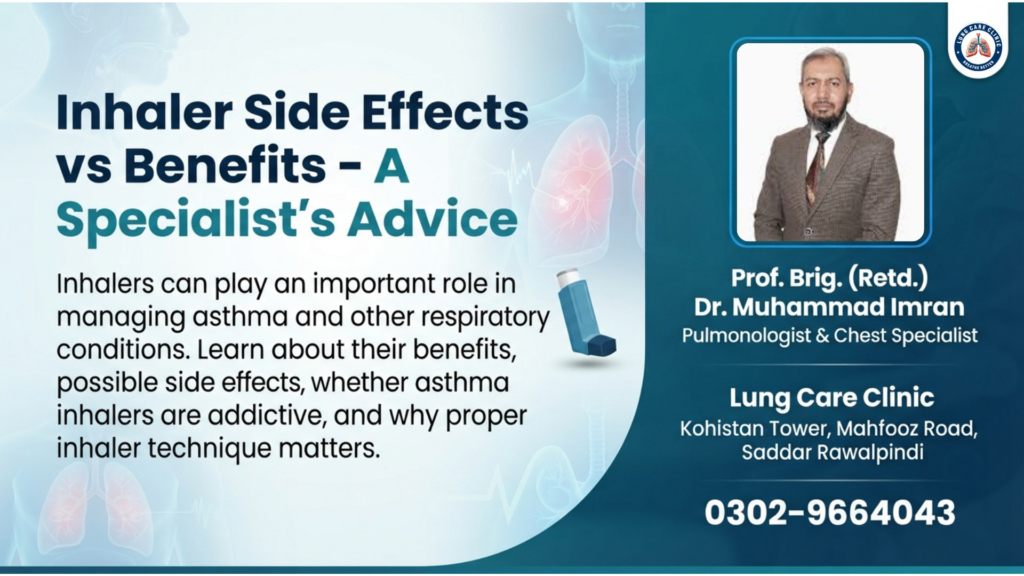
At Lung Care Clinic, Prof. Brig. (Retd.) Dr. Muhammad Imran, Pulmonologist & Chest Specialist, provides specialist respiratory evaluation for asthma, COPD, chronic cough, wheezing, and other breathing problems.
Patients can bring their current inhalers and previous medical reports for review.
The doctor can assess symptoms, discuss inhaler use, review treatment concerns, and recommend further evaluation when appropriate.
What About Long-Term Inhaler Use?
Some patients worry that long-term inhaler use is harmful.
The answer depends on the medicine.
Controller inhalers are prescribed because their benefits can outweigh their risks when used appropriately for patients who need them.
The goal is not simply to use an inhaler indefinitely without review. Instead, treatment should be reviewed regularly to ensure that the medicine, dose, and device remain appropriate.
Patients should also follow the prescribed treatment plan and attend follow-up appointments when recommended.
Inhaler Side Effects and Benefits – Finding the Right Balance
The key issue is not whether inhalers have side effects. Almost all medicines can have potential adverse effects.
The more important question is whether the prescribed medicine provides enough benefit for your particular condition and whether it is being used correctly.
For many patients with asthma or COPD, appropriate inhaled treatment can improve symptom control and daily functioning.
At the same time, possible side effects should not be ignored.
If you experience unwanted effects, do not stop your medicine on your own. Talk to your doctor. The doctor may adjust the device, dose, medicine, or treatment approach when appropriate.
Understanding Inhaler Side Effects and Benefits can help patients make better-informed decisions about respiratory treatment.
Inhalers can provide important benefits for asthma, COPD, and other airway conditions. They can help control symptoms, improve airflow, and reduce respiratory complications when appropriately prescribed.
However, the medicine must be used correctly.
Proper inhaler technique is an important part of treatment. Patients should also understand whether their inhaler is intended for daily control or quick symptom relief.
Asthma inhalers are generally not considered addictive. However, frequent use of a reliever inhaler may indicate that the underlying condition is not well controlled and should be reviewed by a healthcare professional.
If you have questions about inhaler side effects, inhaler technique, or ongoing breathing symptoms, seek individualized medical advice rather than changing treatment yourself.
Prof. Brig. (Retd.) Dr. Muhammad Imran
Pulmonologist & Chest Specialist
Lung Care Clinic
Kohistan Tower, Mahfooz Road, Military Hospital Rd, Opposite AFIC, Saddar, Rawalpindi.
0302-9664043
Serving patients from Rawalpindi & Islamabad.