When a patient needs supplemental oxygen at home, one of the most common questions is: which is more suitable, an oxygen concentrator or an oxygen cylinder? Understanding the difference between an oxygen concentrator vs cylinder in Pakistan can help families prepare for home lung care, but the final choice should always be based on a doctor’s prescription and the patient’s oxygen requirements.
Home oxygen may be recommended for selected patients with chronic lung disease or temporary medical conditions when blood oxygen levels are too low. However, not every patient with COPD, asthma, pneumonia, or another respiratory condition needs oxygen therapy. The prescribed flow rate, number of hours per day, oxygen level, mobility, and overall medical condition all matter.
For families in Pakistan, electricity availability, transportation, equipment maintenance, cylinder refilling, and emergency backup can also affect the practical choice.
What Is an Oxygen Concentrator?
An oxygen concentrator is an electrically powered medical device that takes in normal room air and concentrates the oxygen before delivering it to the patient through equipment such as a nasal cannula.
Unlike a cylinder, a concentrator does not store a fixed amount of oxygen inside a tank. It continues producing concentrated oxygen while the machine is operating and has a reliable power supply.
Stationary concentrators are commonly designed for home use. Portable oxygen concentrators are also available, although their delivery method and oxygen output can differ between models.
The most important point is that a concentrator should be selected according to the prescribed oxygen flow and the patient’s clinical needs rather than simply choosing the largest or cheapest machine.
What Is an Oxygen Cylinder?
An oxygen cylinder stores medical oxygen under pressure inside a metal container. The oxygen is delivered through a regulator and flow-control system connected to the patient’s oxygen tubing or nasal cannula.
The main advantage of a cylinder is that it does not require electricity to deliver oxygen. This can be particularly important during a power outage or when a patient needs oxygen during transportation.
However, a cylinder contains a limited supply. Once the stored oxygen is used, the cylinder must be refilled or replaced.
Therefore, families using cylinders at home need to plan for oxygen availability, transportation, storage, and timely refilling.
Oxygen Concentrator vs Cylinder in Pakistan – Key Differences
The difference between an oxygen concentrator and an oxygen cylinder is mainly related to how oxygen is supplied and how the equipment is used.
Oxygen supply
An oxygen concentrator concentrates oxygen from surrounding air while operating. A cylinder contains a predetermined amount of compressed oxygen.
Therefore, a concentrator can continue operating without a routine oxygen refill as long as it has electricity and remains functional. A cylinder eventually becomes empty and needs replacement or refilling.
Electricity requirement
A stationary oxygen concentrator requires electricity. This means families need a plan for power interruptions.
An oxygen cylinder does not need electricity to provide oxygen. This makes it particularly useful when electricity is unavailable.
Refilling
A concentrator does not require oxygen-cylinder refilling during normal operation.
A cylinder must be refilled or exchanged when its oxygen supply is depleted. For patients who require oxygen for many hours every day, this can become an important part of home-care planning.
Portability
Small oxygen cylinders can be transported when appropriate, although they still contain compressed oxygen and must be handled carefully.
Portable oxygen concentrators are designed for mobility, but their flow options, battery life, and delivery modes vary by model.
Patients should not assume that any portable device can provide the same oxygen support as a stationary unit.
Emergency preparedness
An oxygen cylinder can provide an important backup when a concentrator cannot operate because of a power failure or equipment problem.
For some patients who depend on continuous oxygen, discussing a backup oxygen plan with the treating doctor is important.
Is an Oxygen Concentrator Better Than a Cylinder?
There is no single answer that applies to every patient.
For someone who has a medical prescription for long-duration home oxygen and has reliable electricity, an oxygen concentrator may be practical because it can provide oxygen continuously without repeated cylinder refills.
On the other hand, a cylinder can be valuable when electricity is unavailable, during transportation, or when a temporary oxygen supply is required.
In some situations, a patient may use a concentrator as the main home oxygen source while keeping an appropriate backup oxygen supply available.
The decision should therefore be based on medical requirements and home circumstances rather than on price or convenience alone.
Home Oxygen for COPD: What Patients Should Know
COPD is one condition in which some patients may require supplemental oxygen. However, oxygen is not automatically required simply because someone has COPD.
A pulmonologist may assess symptoms, oxygen levels, disease severity, and other clinical factors before recommending oxygen therapy.
If oxygen has been prescribed, the patient should follow the prescribed flow rate and duration.
Increasing oxygen flow independently does not necessarily provide better treatment and may be unsafe for some patients. Similarly, reducing or stopping prescribed oxygen without medical advice can be harmful.
Patients should discuss any concerns about oxygen levels, breathlessness, equipment, or oxygen duration with their healthcare provider.
Can Home Oxygen Be Used for Asthma?
Asthma treatment and oxygen therapy are not the same thing.
Most people with asthma do not require long-term home oxygen simply because they have asthma. During a severe asthma attack, oxygen may be used in an appropriate medical setting when oxygen levels are low.
Long-term home oxygen should only be considered when there is a medical indication.
If someone with asthma is frequently experiencing breathlessness, wheezing, nighttime symptoms, or repeated attacks, the priority is proper assessment and asthma management rather than purchasing oxygen equipment without medical advice.
Oxygen Concentrator and Load-Shedding in Pakistan
Electricity reliability is an important practical consideration when choosing home oxygen equipment in Pakistan.
A stationary oxygen concentrator cannot produce oxygen when its power supply is interrupted. Therefore, patients who depend on a concentrator should discuss an appropriate backup plan.
Depending on the household and medical situation, this may involve a suitable backup power system or an oxygen cylinder for emergencies.
The exact backup arrangement should be planned according to how dependent the patient is on oxygen and how long electricity interruptions may last.
A patient who requires continuous oxygen should not wait until a power outage occurs before thinking about backup arrangements.
Oxygen Cylinder Safety at Home
Oxygen supports combustion, so appropriate fire safety is essential regardless of whether oxygen comes from a concentrator or cylinder.
For oxygen cylinders, families should pay particular attention to secure storage and handling.
Important precautions include:
- Keep oxygen equipment away from open flames.
- Do not smoke near oxygen equipment.
- Keep cylinders upright and properly secured.
- Keep cylinders away from excessive heat.
- Do not allow oil, grease, or other unsuitable substances to come into contact with oxygen equipment.
- Use the correct regulator and prescribed flow setting.
- Keep equipment in a well-managed, safe area.
- Follow the supplier’s instructions for storage and handling.
Family members and caregivers should understand these precautions before home oxygen therapy begins.
Oxygen Concentrator Safety at Home
Although an oxygen concentrator does not store compressed oxygen in the same way as a cylinder, it still requires careful use.
The machine needs a suitable electrical supply and adequate ventilation around the device. Filters and other components should be maintained according to the manufacturer’s instructions.
Patients should also avoid smoking or allowing open flames near oxygen equipment.
A concentrator should not be placed where its air intake or ventilation openings are blocked.
If the machine develops an unusual alarm, malfunction, overheating problem, or other concerning issue, the patient or caregiver should follow the manufacturer’s instructions and contact the appropriate equipment provider or healthcare professional.
What Flow Rate Do I Need?
One of the most important questions about home oxygen is the required flow rate.
Oxygen flow is commonly expressed in liters per minute, but the correct flow rate is not something a patient should select based on the machine’s capacity.
For example, purchasing a machine capable of delivering a higher flow does not mean that the patient should automatically receive a higher flow.
The prescribed oxygen flow should come from the treating healthcare professional.
The doctor may also specify whether oxygen is required continuously, during sleep, during activity, or only under particular circumstances.
Therefore, families should take the prescription into account before buying or renting an oxygen concentrator or cylinder.
Oxygen Concentrator vs Cylinder Cost in Pakistan
The total cost of home oxygen care depends on several factors.
For a concentrator, costs can include:
- Purchase or rental cost
- Electricity consumption
- Maintenance
- Filters and replacement parts
- Repairs
- Backup power arrangements
For a cylinder, costs can include:
- Cylinder purchase or rental
- Oxygen refilling
- Transportation
- Regulator and accessories
- Replacement or maintenance
- Emergency backup arrangements
Because prices and availability vary between suppliers and cities, families should confirm current local prices before making a purchase.
More importantly, the cheapest equipment is not necessarily appropriate if it cannot meet the prescribed flow or does not have adequate service support.
Should You Buy or Rent an Oxygen Concentrator?
Renting may be worth considering when oxygen is required temporarily.
For example, some patients may need oxygen for a limited period following a medical illness while their condition is being reassessed.
Buying may be considered when a patient has an ongoing need for prescribed home oxygen.
However, the decision depends on the expected duration of treatment, equipment availability, maintenance support, and financial circumstances.
A healthcare professional can help determine the clinical requirement, while a reputable equipment provider can explain rental, purchase, servicing, and backup options.
Oxygen Therapy for COPD and Other Lung Conditions
Supplemental oxygen may be used in selected patients with chronic lung diseases when there is clinically significant low blood oxygen.
Conditions that may sometimes be associated with oxygen therapy include certain cases of COPD, interstitial lung disease, pulmonary fibrosis, and other chronic respiratory disorders.
However, the presence of a lung disease alone does not automatically mean that home oxygen is required.
A proper assessment is important because breathlessness can have multiple causes.
For example, shortness of breath may be related to lung disease, heart disease, anemia, infection, deconditioning, or other medical conditions.
The reason for low oxygen should therefore be assessed before establishing a long-term home oxygen plan.
What Should Families Check Before Choosing Equipment?
Before purchasing an oxygen concentrator or cylinder, families should consider several questions:
- Has oxygen therapy actually been prescribed?
- What oxygen flow rate has the doctor recommended?
- How many hours per day is oxygen required?
- Is oxygen needed during sleep?
- Is oxygen needed during physical activity?
- Is the patient mobile outside the home?
- Is electricity reliable at home?
- Is backup power available?
- Is a backup oxygen cylinder required?
- Is servicing available locally?
- Are replacement parts and accessories accessible?
- Does the equipment match the prescribed oxygen requirement?
Answering these questions can prevent families from buying equipment that does not meet the patient’s needs.
When Should You Consult a Pulmonologist?
A specialist respiratory assessment is particularly important when a patient has persistent breathlessness, low oxygen readings, worsening COPD symptoms, chronic lung disease, repeated respiratory infections, or difficulty managing oxygen therapy.
A pulmonologist can evaluate the underlying respiratory condition and determine whether supplemental oxygen is appropriate.
If oxygen has already been prescribed, the specialist can also help review the required flow, timing, and overall treatment plan.
Patients should seek urgent medical attention for severe or rapidly worsening breathlessness, blue or grey lips, confusion, severe chest pain, fainting, or other serious symptoms.
Oxygen Concentrator vs Cylinder in Pakistan – Final Considerations
The choice between an oxygen concentrator and an oxygen cylinder depends on the patient, not simply the equipment.
An oxygen concentrator can be practical for prescribed long-term home oxygen because it produces concentrated oxygen while powered and does not require routine oxygen refilling. However, it depends on electricity and therefore requires appropriate planning for power interruptions.
An oxygen cylinder provides stored oxygen without requiring electricity, making it useful for certain short-term situations, transportation, and backup planning. However, its oxygen supply is finite and requires refilling or replacement.
For some patients, the most practical home-care arrangement may involve a concentrator as the primary source and an appropriate backup plan for power failures. For others, a cylinder may be suitable depending on their prescription and circumstances.
Most importantly, do not start oxygen therapy, change the flow rate, or stop prescribed oxygen without medical advice.
If you or a family member has COPD, chronic lung disease, persistent breathing difficulty, or concerns about oxygen levels, discuss the appropriate oxygen plan with a qualified respiratory specialist.
Specialist Respiratory Care in Rawalpindi
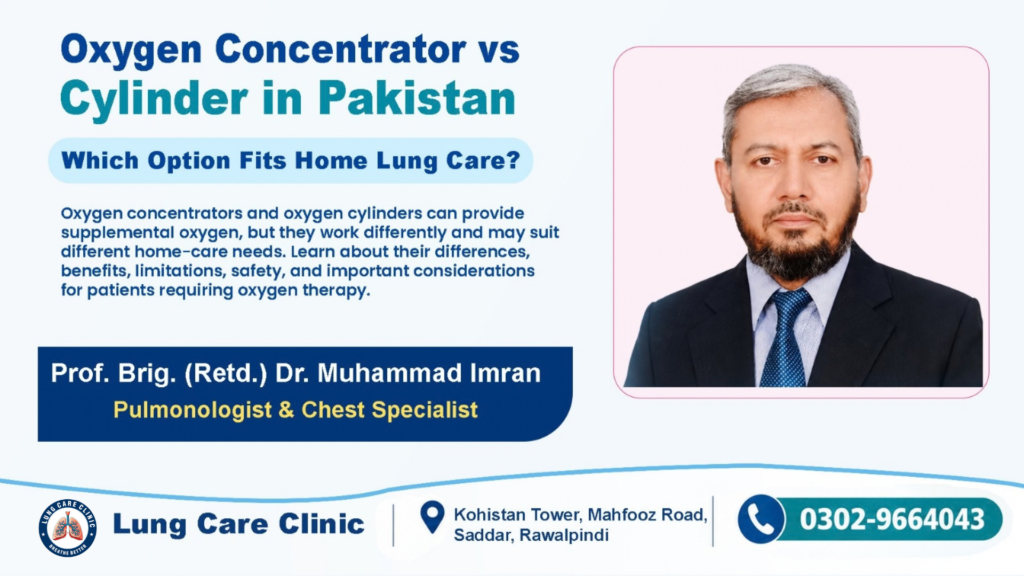
At Lung Care Clinic, Prof. Brig. (Retd.) Dr. Muhammad Imran, Pulmonologist & Chest Specialist, provides specialist respiratory evaluation and guidance for patients with breathing difficulties and chronic lung conditions.
If you have been advised to use oxygen at home and are unsure whether an oxygen concentrator or cylinder is appropriate for your situation, discuss your oxygen requirements with a respiratory specialist before making a decision.
Lung Care Clinic
Prof. Brig. (Retd.) Dr. Muhammad Imran
Kohistan Tower, Mahfooz Road, Saddar, Rawalpindi
0302-9664043
Medical information in this article is for general educational purposes and does not replace an individual medical assessment or prescription.