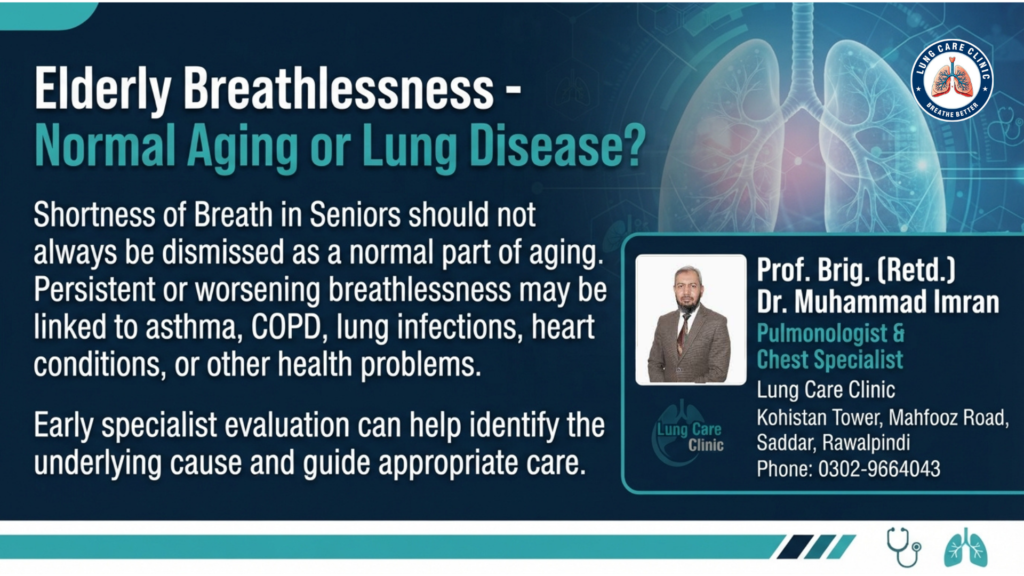
Shortness of Breath in Seniors should not always be considered a normal part of aging. Older adults can experience some changes in breathing capacity as they age. However, new, persistent, worsening, or unexplained breathlessness may have an underlying cause that needs medical evaluation. Lung diseases, heart conditions, respiratory infections, anemia, medication effects, reduced physical activity, and other health problems can contribute to breathing difficulty.
For families caring for an older adult, recognizing changes in breathing is important. A senior who becomes breathless during routine activities, needs more rest while walking, wakes up because of breathing difficulty, or develops a persistent cough may need a medical assessment.
The cause is not always a serious disease. However, identifying the reason can help doctors recommend appropriate treatment and support better daily functioning.
Is Shortness of Breath Normal in Older Adults?
Aging can bring changes to the respiratory system. Lung tissue can become less elastic, respiratory muscles may become weaker, and the chest wall can become less flexible. Physical activity may also decrease with age.
As a result, some older adults may notice reduced exercise tolerance.
However, significant or new breathlessness should not automatically be blamed on age.
For example, becoming mildly winded after strenuous activity can be different from becoming breathless while walking across a room. Similarly, a gradual reduction in exercise capacity may require a different assessment from sudden breathing difficulty.
Therefore, the pattern, severity, duration, and associated symptoms all matter.
How Aging Can Affect Breathing
The respiratory system changes gradually throughout life.
Older adults may experience:
- Reduced lung elasticity
- Changes in chest wall movement
- Reduced respiratory muscle strength
- Lower maximum breathing capacity
- Reduced exercise tolerance
- Changes in the body’s response to low oxygen or high carbon dioxide
These changes can reduce the body’s breathing reserve.
Nevertheless, healthy aging does not mean that an older person should routinely struggle to breathe during ordinary activities.
When breathlessness becomes noticeable or affects daily life, an underlying cause should be considered.
Common Causes of Shortness of Breath in Seniors
There are many possible causes of breathing difficulty in older adults.
Some of the more common causes include lung disease, heart disease, infections, anemia, physical deconditioning, and medication-related effects.
Asthma
Asthma can occur at any age, including later adulthood.
Older adults may experience:
- Wheezing
- Cough
- Chest tightness
- Shortness of breath
- Symptoms that worsen at certain times or after specific triggers
Asthma symptoms can sometimes overlap with other conditions. Therefore, proper evaluation is important.
COPD
Chronic obstructive pulmonary disease, or COPD, is an important cause of persistent breathing difficulty in older adults.
COPD can cause:
- Long-term cough
- Mucus production
- Wheezing
- Breathlessness during physical activity
- Reduced exercise tolerance
A history of smoking or long-term exposure to lung irritants can increase the risk.
However, not every person with COPD has the same symptoms or severity.
Pneumonia and Other Chest Infections
Respiratory infections can cause significant breathing problems in older adults.
Pneumonia may cause cough, fever, weakness, chest discomfort, mucus production, and shortness of breath.
Older adults may sometimes have less typical symptoms than younger people. A sudden decline in activity, confusion, weakness, or reduced appetite can accompany an infection.
Prompt medical assessment can be important when an older person becomes suddenly unwell.
Interstitial Lung Disease
Interstitial lung diseases affect the lung tissue and can cause progressive breathlessness.
Some patients may also develop a persistent dry cough and reduced exercise capacity.
Because many conditions can produce similar symptoms, doctors may use lung function testing and chest imaging when appropriate.
Pulmonary Fibrosis
Pulmonary fibrosis causes scarring of lung tissue.
As the disease progresses, the lungs may become less able to transfer oxygen efficiently.
Patients may experience gradually increasing breathlessness, particularly during physical activity, along with a persistent dry cough.
The cause of pulmonary fibrosis varies, so specialist evaluation is important.
Heart Conditions Can Also Cause Breathlessness
Not every breathing problem comes from the lungs.
Heart conditions can also produce shortness of breath.
For example, heart failure can cause breathlessness during activity or when lying down. Some people may also develop swelling in the legs, fatigue, or difficulty sleeping because of breathing problems.
Older adults may have both heart and lung conditions at the same time.
Therefore, a complete evaluation may need to consider both systems.
A pulmonologist may also recommend cardiac assessment when the symptoms suggest a possible heart-related cause.
Shortness of Breath in Seniors While Walking
Breathlessness while walking is a common concern among older adults.
Some people become mildly winded after walking quickly or climbing stairs. However, a noticeable change in exercise tolerance deserves attention.
For example, a senior who previously walked comfortably but now becomes breathless after a short distance may have an underlying condition.
Possible causes include:
- COPD
- Asthma
- Heart disease
- Lung infection
- Interstitial lung disease
- Anemia
- Physical deconditioning
- Obesity
- Medication effects
The important point is to identify what has changed and why.
Breathlessness at Night in Older Adults
Nighttime breathing difficulty can have several causes.
Some older adults may wake up feeling short of breath. Others may experience coughing or difficulty breathing when lying flat.
Possible causes can include:
- Asthma
- COPD
- Heart failure
- Sleep-related breathing disorders
- Respiratory infections
- Other lung conditions
Nighttime symptoms should be discussed with a healthcare professional, particularly when they occur repeatedly.
A detailed medical history can help determine whether additional lung, heart, or sleep-related evaluation is needed.
Can Sleep Apnea Cause Breathing Problems?
Sleep apnea is common and becomes more important to consider when an older person snores heavily, pauses breathing during sleep, wakes frequently, or feels excessively tired during the day.
Obstructive sleep apnea occurs when the upper airway repeatedly becomes blocked during sleep.
It can cause disrupted sleep and may contribute to daytime fatigue.
A sleep-related breathing disorder can require a different evaluation from ordinary daytime breathlessness. A doctor can determine whether a sleep assessment is appropriate.
Warning Signs That Need Prompt Medical Attention
Some breathing symptoms require urgent medical assessment.
Seek emergency care if an older person develops severe or sudden breathing difficulty, particularly when it occurs with:
- Chest pain or pressure
- Fainting or near-fainting
- Blue or gray lips or skin
- Severe weakness
- Confusion
- Sudden inability to speak normally because of breathlessness
- Coughing up a significant amount of blood
- Sudden severe symptoms after a period of being well
Sudden breathlessness can sometimes occur with serious conditions such as pulmonary embolism, severe infection, pneumothorax, or acute heart problems.
Do not assume sudden symptoms are simply related to age.
How Is Breathlessness in Seniors Evaluated?
A doctor will usually begin by asking detailed questions.
These may include:
- When did the breathlessness begin?
- Does it occur at rest or during activity?
- Has it been getting worse?
- Does it occur at night?
- Is there a cough?
- Is mucus present?
- Is there wheezing?
- Is there chest discomfort?
- Has there been fever?
- Has there been unexplained weight loss?
- Is there a history of smoking?
- Are there previous lung or heart conditions?
- What medicines does the patient take?
The doctor may then perform a physical examination.
Depending on the findings, additional tests may be recommended.
Lung Function Testing
Lung function testing can help evaluate how well the lungs move air.
Spirometry is one commonly used lung function test. It can help assess airflow obstruction and may support the evaluation of conditions such as asthma and COPD.
Other pulmonary function tests may be considered when more detailed information is needed.
The exact tests depend on the patient’s symptoms and clinical findings.
Chest Imaging
Chest imaging may also help identify possible causes of breathlessness.
A chest X-ray can provide information about the lungs and chest structures.
In selected cases, a CT scan may provide more detailed information.
Imaging should be interpreted together with the patient’s symptoms, examination, and other test results.
Blood Tests and Other Assessments
Blood tests may be useful when conditions such as anemia or infection are suspected.
Doctors may also assess oxygen levels using pulse oximetry when appropriate.
If the symptoms suggest a cardiac cause, further heart-related assessment may be needed.
The goal is not simply to identify that an older person is breathless. The goal is to determine why the breathlessness is occurring.
Why Medication Review Matters
Older adults often take several medicines for different health conditions.
Some medications can affect breathing, heart rate, blood pressure, fluid balance, or alertness.
Therefore, medication history is an important part of evaluating new symptoms.
Patients should not stop prescribed medicines on their own.
Instead, tell the doctor about all prescription medicines, over-the-counter medicines, and supplements being used.
The doctor can then determine whether any medication may be contributing to the symptoms.
Physical Deconditioning and Breathlessness
Reduced physical activity can also contribute to breathlessness.
When someone becomes inactive for a long period, muscles become less conditioned. Ordinary activities may then require more effort.
This can create a cycle:
Reduced activity → lower fitness → greater effort during activity → breathlessness → further reduction in activity.
However, physical deconditioning should only be considered after appropriate medical causes have been assessed when symptoms are significant or new.
An older adult should not be told that breathlessness is simply due to poor fitness without considering other possibilities.
When Should an Elderly Person See a Pulmonologist?
A pulmonologist may be appropriate when breathing symptoms are persistent, recurrent, unexplained, or associated with known lung disease.
Consider specialist respiratory evaluation when an older adult has:
- Persistent shortness of breath
- Chronic cough
- Recurrent wheezing
- Frequent chest infections
- Reduced walking tolerance
- Repeated nighttime breathing problems
- Known COPD or asthma
- Abnormal chest imaging
- A history of significant smoking exposure
- Unexplained changes in respiratory symptoms
A pulmonologist can review the patient’s history, examination findings, previous reports, medications, and lung function when appropriate.
Shortness of Breath in Seniors – Why Early Evaluation Matters
Shortness of breath can have many different causes.
In older adults, several conditions can also exist together. For example, a person may have COPD and heart disease at the same time. Another person may have asthma combined with reduced physical activity.
Because of this, treating the symptom alone may not address the underlying problem.
A proper medical assessment can help identify whether the breathlessness relates to the lungs, heart, blood, medications, fitness, or another condition.
Specialist Respiratory Care for Seniors in Rawalpindi
Families searching for a pulmonologist in Rawalpindi may need specialist evaluation when an older family member develops persistent or unexplained breathing difficulty.
At Lung Care Clinic, Prof. Brig. (Retd.) Dr. Muhammad Imran, Pulmonologist & Chest Specialist, provides specialist respiratory assessment for patients with breathing problems, chronic cough, asthma, COPD, chest infections, and other pulmonary concerns.
The evaluation can include a review of symptoms, medical history, previous reports, medication use, and appropriate respiratory investigations when clinically indicated.
Older patients can bring their previous chest X-rays, CT scans, prescriptions, lung function reports, and other relevant medical records to the consultation.
Practical Tips for Families Caring for an Elderly Patient
Family members can help by observing changes in breathing and daily activity.
Pay attention to:
- New breathlessness
- Increasing breathlessness
- Reduced walking distance
- More frequent rest periods
- New or worsening cough
- Wheezing
- Changes in sleep due to breathing problems
- Recurrent chest infections
- Changes in appetite or weight
- Difficulty performing normal daily activities
Keep a record of when symptoms occur.
This information can help the doctor understand the pattern and plan an appropriate evaluation.
Shortness of Breath in Seniors should not automatically be dismissed as normal aging.
Although aging can reduce respiratory reserve and exercise capacity, persistent, worsening, or unexplained breathlessness may indicate an underlying lung, heart, blood, medication-related, or other medical problem.
Asthma, COPD, chest infections, interstitial lung disease, heart conditions, sleep-related breathing disorders, anemia, and physical deconditioning are among the possible causes.
The right evaluation depends on the individual patient.
If an older adult develops significant breathing difficulty, particularly sudden or severe symptoms, prompt medical attention is important.
For persistent or unexplained respiratory symptoms, specialist evaluation can help identify the underlying cause and guide appropriate care.
Prof. Brig. (Retd.) Dr. Muhammad Imran
Pulmonologist & Chest Specialist
Lung Care Clinic
Kohistan Tower, Mahfooz Road, Military Hospital Rd, Opposite AFIC, Saddar, Rawalpindi,
0302-9664043
Serving patients from Rawalpindi & Islamabad.