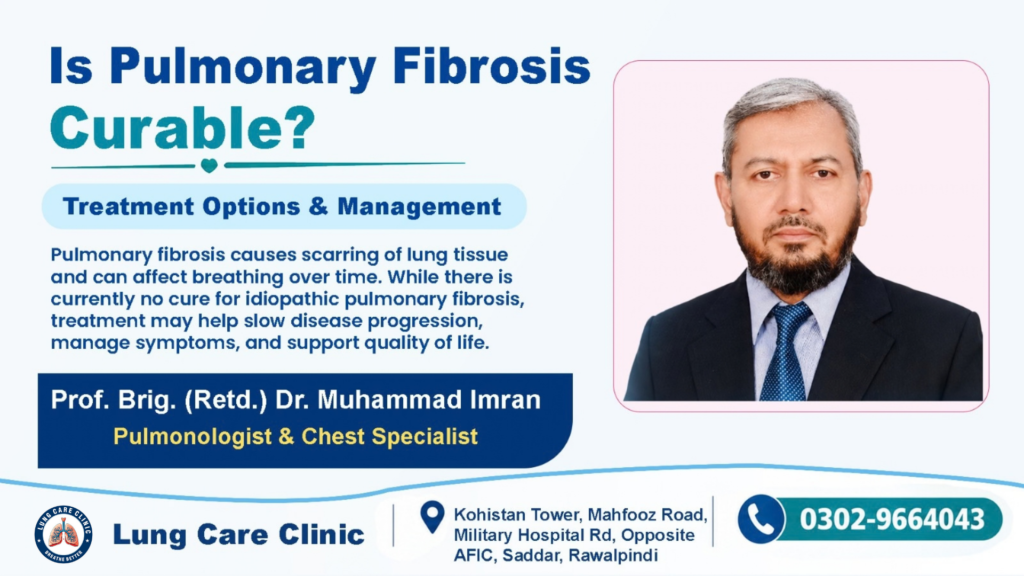
Is pulmonary fibrosis curable? This is one of the first questions many people ask after hearing that their lungs have developed scarring. The answer depends partly on the type and cause of pulmonary fibrosis. For idiopathic pulmonary fibrosis (IPF), the most common form of pulmonary fibrosis, there is currently no cure. However, modern treatments can help slow disease progression, manage symptoms, maintain physical function, and improve quality of life.
Pulmonary fibrosis describes a group of conditions in which lung tissue becomes scarred and stiff. As fibrosis develops, the lungs may become less able to expand normally, and oxygen can have more difficulty moving from the air sacs into the bloodstream. This can lead to persistent cough, shortness of breath, fatigue, and reduced exercise tolerance.
An important point is that pulmonary fibrosis is not one single disease. It can occur for different reasons, including autoimmune conditions, environmental or occupational exposures, certain medications, genetic factors, and unknown causes. Therefore, treatment needs to be tailored to the specific diagnosis.
Is Pulmonary Fibrosis Curable?
For idiopathic pulmonary fibrosis, there is currently no cure that removes established lung scarring. Existing treatment focuses on slowing further damage, controlling symptoms, supporting daily activity, and maintaining quality of life.
This does not mean that treatment is ineffective.
Some medicines can slow the rate at which fibrosis progresses. Other measures, such as pulmonary rehabilitation and appropriately prescribed oxygen therapy, can help patients manage the effects of reduced lung function.
The course of pulmonary fibrosis also varies from person to person. Some people experience gradual progression over many years, while others experience more rapid deterioration. Regular specialist monitoring is therefore important.
What Is Pulmonary Fibrosis?
Pulmonary fibrosis means scarring of lung tissue. The scarring can make normally flexible lung tissue thicker and stiffer.
When the lungs become less flexible, breathing may require more effort. In addition, the transfer of oxygen into the blood can become less efficient.
Pulmonary fibrosis falls within the broader group of interstitial lung diseases (ILDs). Some ILDs involve inflammation, some involve scarring, and some develop both inflammation and fibrosis.
Idiopathic pulmonary fibrosis is called “idiopathic” because its exact cause is not known.
Other forms of lung fibrosis may be associated with:
- Autoimmune diseases
- Occupational exposures
- Environmental irritants
- Certain medications
- Previous lung injury
- Genetic factors
- Other interstitial lung diseases
Identifying the underlying cause is important because the treatment strategy may be different.
What Are the Symptoms of Pulmonary Fibrosis?
Pulmonary fibrosis may develop gradually. Some people have mild symptoms initially and may not realize that their lung function is changing.
Common symptoms include:
- Persistent dry cough
- Shortness of breath
- Breathlessness during physical activity
- Reduced exercise tolerance
- Fatigue
- Difficulty performing routine activities
- Unexplained weight loss in some cases
As the disease progresses, breathlessness may occur with increasingly minor activities and, in advanced disease, may occur even at rest.
However, these symptoms are not specific to pulmonary fibrosis. Asthma, COPD, heart disease, anemia, infections, and other conditions can also cause breathlessness or cough.
That is why a proper diagnostic evaluation is important.
How Is Pulmonary Fibrosis Diagnosed?
Diagnosing pulmonary fibrosis can require several types of information.
A pulmonologist may begin with a detailed medical history and physical examination. The doctor may ask about smoking, occupational exposures, environmental exposures, medications, autoimmune symptoms, family history, previous infections, and changes in exercise tolerance.
Additional tests may include:
Chest Imaging
High-resolution CT scanning can provide detailed information about the lung tissue and patterns of fibrosis.
The appearance and distribution of scarring can help doctors distinguish between different types of interstitial lung disease.
Pulmonary Function Tests
Lung function testing can help determine how well the lungs are working.
These tests may measure lung volumes and how efficiently the lungs transfer gases.
Repeating pulmonary function tests over time can also help doctors assess whether lung function is changing.
Blood Tests
Blood tests may help investigate autoimmune diseases and other possible causes of interstitial lung disease.
Oxygen Assessment
Oxygen levels may be assessed at rest and, when appropriate, during activity.
Specialist Review
Because several lung conditions can resemble one another, specialist interpretation of the symptoms, imaging, lung function, and laboratory findings is important.
Can Lung Scarring Be Reversed?
This is another common question: can lung scarring be reversed?
Established fibrotic scar tissue is generally considered permanent. Current treatments for pulmonary fibrosis are not designed to remove existing scar tissue. Instead, treatment aims to slow additional scarring when possible and manage the consequences of reduced lung function.
This distinction is important.
If a patient is told that treatment may slow lung scarring, it does not mean that the existing scar tissue will disappear.
The goal is to preserve as much lung function and quality of life as possible.
Medicines That May Slow Lung Fibrosis
For some forms of pulmonary fibrosis, medications may help slow disease progression.
In idiopathic pulmonary fibrosis, antifibrotic medicines are an important part of treatment. Examples include nintedanib and pirfenidone. Current sources also identify nerandomilast as an approved antifibrotic option for IPF in the United States.
These medicines do not remove established scar tissue. Their purpose is to slow the rate of further fibrosis.
Medication selection depends on the patient’s diagnosis, disease severity, other health conditions, potential side effects, and the treating specialist’s assessment.
Patients should not start, stop, or change antifibrotic medication without medical guidance.
Treatment for Other Forms of Pulmonary Fibrosis
Not every case of pulmonary fibrosis is idiopathic pulmonary fibrosis.
Some forms of interstitial lung disease are associated with autoimmune or inflammatory conditions. In these situations, treatment may involve medicines that control inflammation or immune-system activity.
The appropriate medication depends on the underlying disease.
This is one reason why simply searching for a “pulmonary fibrosis cure” and taking medication without a confirmed diagnosis can be inappropriate.
A treatment that may be useful for one type of ILD may not be appropriate for another.
Can Treatment Slow Lung Scarring?
Yes, treatment can slow progression in some forms of pulmonary fibrosis.
For IPF, antifibrotic medications are designed to slow the decline associated with fibrosis. For progressive pulmonary fibrosis occurring in some non-IPF interstitial lung diseases, treatment may also include medications that address the underlying disease and, in appropriate patients, antifibrotic therapy.
However, not every patient progresses at the same rate.
Some patients may remain relatively stable for a period, while others experience more noticeable decline.
Regular monitoring helps the healthcare team recognize changes in symptoms, lung function, and imaging.
Pulmonary Rehabilitation
Pulmonary rehabilitation can be an important part of pulmonary fibrosis management.
It typically combines supervised physical activity or exercise training with education and support.
The goal is not to remove lung scarring.
Instead, pulmonary rehabilitation can help patients improve exercise tolerance, manage breathlessness, maintain physical activity, and perform daily activities more effectively.
A personalized rehabilitation program should take the patient’s lung function, oxygen needs, physical condition, and other medical problems into account.
Oxygen Therapy for Pulmonary Fibrosis
Some people with pulmonary fibrosis develop low blood oxygen levels.
When oxygen levels are low, a healthcare professional may prescribe supplemental oxygen. Oxygen therapy can help reduce breathlessness related to low oxygen and may make physical activity easier for appropriate patients.
However, oxygen is not automatically required for everyone with pulmonary fibrosis.
The need for oxygen should be assessed clinically. The prescribed flow rate and duration should also be followed carefully.
Patients should not purchase an oxygen concentrator or start home oxygen simply because they have been diagnosed with lung fibrosis.
Lifestyle and Lung Protection
Medical treatment is only one part of pulmonary fibrosis management.
Patients should also work with their healthcare team to protect their lungs and maintain overall health.
Helpful measures may include:
- Avoiding smoking
- Avoiding secondhand smoke
- Reducing exposure to harmful dust and fumes
- Following prescribed treatment
- Staying physically active within safe limits
- Maintaining adequate nutrition
- Keeping recommended vaccinations up to date
- Attending scheduled follow-up appointments
- Reporting new or worsening symptoms promptly
Avoiding occupational and environmental exposures can be particularly important when exposure may have contributed to the lung disease.
Progressive Pulmonary Fibrosis
Some people with non-IPF interstitial lung disease develop a pattern called progressive pulmonary fibrosis (PPF).
PPF is not a separate single disease. It describes worsening lung scarring in some people with ILD.
Doctors may look for changes such as worsening symptoms, declining lung function, or increasing fibrosis on imaging when assessing progression.
Recognizing progression matters because treatment may need to be reassessed.
If symptoms are becoming worse despite treatment, patients should not simply assume that the disease is following its normal course. A specialist may need to review the diagnosis, medication, oxygen needs, rehabilitation plan, and other factors.
Can a Lung Transplant Cure Pulmonary Fibrosis?
For selected patients with advanced pulmonary fibrosis, lung transplantation may be considered.
A lung transplant replaces one or both diseased lungs with donor lungs. It is a major procedure and is not suitable for everyone.
Potential candidates require detailed assessment of their overall health, lung disease severity, other medical conditions, and ability to undergo major surgery and long-term follow-up.
A transplant should therefore not be described as a routine cure for pulmonary fibrosis. It is an advanced treatment option for carefully selected patients.
When Should You See a Pulmonologist for Lung Fibrosis?
You should consider specialist evaluation if you have persistent or unexplained:
- Shortness of breath
- Dry cough
- Reduced exercise tolerance
- Fatigue associated with breathing problems
- Abnormal chest imaging
- Low oxygen levels
- Known interstitial lung disease
- Worsening respiratory symptoms despite treatment
Early specialist assessment can help establish the correct diagnosis and determine whether the disease is stable or progressing.
Patients who already have pulmonary fibrosis should also report significant changes in breathing, exercise tolerance, cough, oxygen levels, or general health.
Sudden severe breathlessness, chest pain, confusion, blue or grey lips, fainting, or rapidly worsening symptoms require urgent medical attention.
Pulmonary Fibrosis Treatment in Rawalpindi
For patients searching for pulmonary fibrosis treatment in Rawalpindi, a specialist respiratory assessment is an important first step.
At Lung Care Clinic, Brigadier (R) Prof. Dr. Muhammad Imran, Pulmonologist & Chest Specialist, provides specialist evaluation and management guidance for respiratory conditions, including complex lung problems.
If you have been diagnosed with lung fibrosis or have symptoms that may suggest an interstitial lung disease, specialist evaluation can help clarify the diagnosis and determine the appropriate management approach.
Treatment may involve medication, monitoring, pulmonary rehabilitation, oxygen assessment, lifestyle measures, or referral for advanced care when clinically appropriate.
The goal is not to promise that existing lung scars can be removed. Instead, appropriate management aims to identify the cause, slow progression where possible, manage symptoms, preserve function, and support quality of life.
Lung Care Clinic
Brigadier (R) Prof. Dr. Muhammad Imran
Kohistan Tower, Mahfooz Road, Saddar, Rawalpindi
0302-9664043
Is pulmonary fibrosis curable? At present, there is no cure for idiopathic pulmonary fibrosis, and established lung scarring generally cannot simply be reversed. However, this does not mean that nothing can be done.
Treatment options have an important role in slowing disease progression, managing symptoms, maintaining physical function, and improving quality of life. Depending on the type of pulmonary fibrosis, treatment may include antifibrotic medicines, treatment for an underlying inflammatory or autoimmune condition, pulmonary rehabilitation, appropriately prescribed oxygen therapy, lifestyle measures, and, in selected advanced cases, lung transplantation.
Because pulmonary fibrosis includes different diseases with different causes and treatment strategies, a personalized diagnosis is essential.
If you are experiencing persistent dry cough, unexplained breathlessness, declining exercise tolerance, or have already been told that you have lung scarring, consult a pulmonologist for appropriate evaluation and ongoing management.
Medical information in this article is for educational purposes and does not replace an individual medical examination, diagnosis, or treatment plan.