COPD and asthma are two common respiratory conditions that can affect breathing. Both can cause coughing, wheezing, chest tightness, and shortness of breath. Because these symptoms overlap, many people wonder whether they have asthma or COPD.
However, COPD and asthma are not the same condition.
The causes, disease patterns, risk factors, and treatment approaches can differ. In addition, some people can have features of both conditions. Therefore, symptoms alone may not always provide a clear answer.
If you regularly experience breathing problems, a pulmonologist can evaluate your symptoms and determine which tests may help clarify the diagnosis.
Understanding the difference between COPD and asthma can also help you recognize when you should seek medical advice.
What Is Asthma?
Asthma is a chronic condition that affects the airways.
People with asthma can develop airway inflammation and increased sensitivity. The muscles around the airways may also tighten during an episode. As a result, airflow can become more difficult.
Asthma symptoms can vary over time.
Some people experience symptoms only occasionally. Others have more frequent symptoms that require regular treatment.
Common asthma symptoms include:
- Wheezing
- Coughing
- Shortness of breath
- Chest tightness
- Breathing difficulty during exercise
- Nighttime or early-morning symptoms
Certain triggers can make asthma symptoms worse.
These may include allergens, respiratory infections, smoke, air pollution, cold air, exercise, and other individual triggers.
Because asthma patterns vary, each patient needs an individualized assessment and treatment plan.
What Is COPD?
COPD stands for chronic obstructive pulmonary disease.
It describes a group of long-term lung conditions that cause persistent airflow limitation. The two major conditions commonly associated with COPD are chronic bronchitis and emphysema.
COPD usually develops gradually.
Long-term exposure to tobacco smoke is a major risk factor. However, other exposures and factors can also contribute to COPD.
These may include:
- Long-term exposure to air pollution
- Occupational dust
- Chemical fumes
- Biomass smoke
- Certain genetic factors
- Repeated exposure to respiratory irritants
Common COPD symptoms include:
- Persistent cough
- Increased mucus production
- Shortness of breath
- Wheezing
- Reduced exercise tolerance
- Chest discomfort in some patients
- Fatigue
Symptoms can become more noticeable as the disease progresses.
Furthermore, COPD can cause flare-ups, known as exacerbations. During an exacerbation, coughing, mucus production, and breathing difficulty can suddenly become worse.
COPD vs Asthma Symptoms
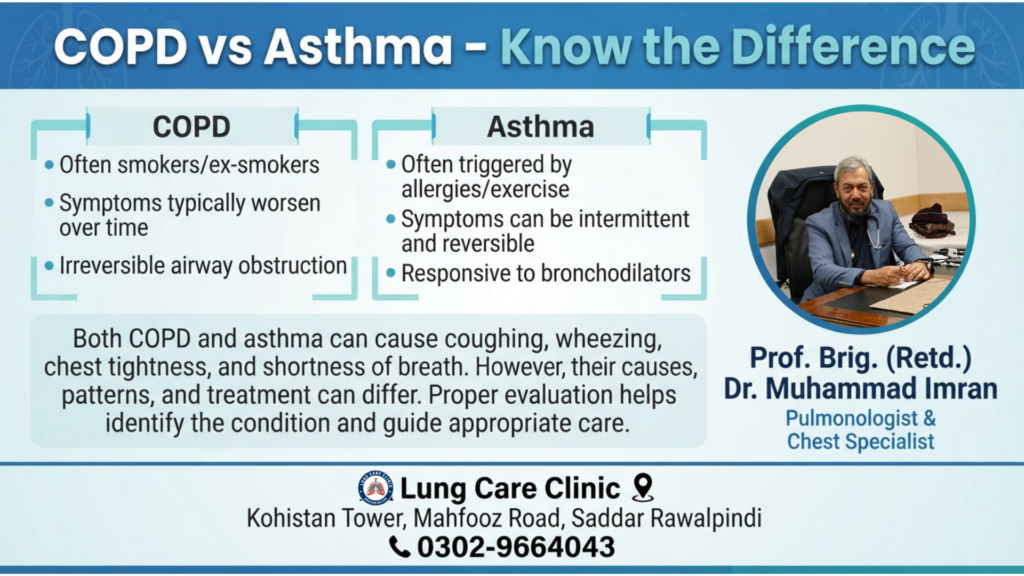
One of the most important points when comparing COPD vs asthma is that their symptoms can overlap.
Both conditions can cause:
- Cough
- Wheezing
- Shortness of breath
- Chest tightness
- Breathing difficulty
- Reduced ability to exercise
Therefore, simply having wheezing does not prove that someone has asthma.
Likewise, having a chronic cough does not automatically mean that someone has COPD.
The pattern of symptoms provides additional information.
Asthma symptoms may vary considerably from one time to another. Some patients have symptom-free periods and then develop episodes after exposure to a trigger.
COPD symptoms often develop gradually and may become persistent over time. Patients may notice increasing breathlessness during walking, climbing stairs, or other physical activities.
Still, individual cases can differ.
That is why proper evaluation remains important.
Difference Between Asthma and COPD
The difference between asthma and COPD involves several factors.
Asthma often involves variable airway narrowing and inflammation. Symptoms may come and go, and certain triggers can produce temporary worsening.
COPD usually involves persistent airflow limitation. The condition often develops gradually and is commonly associated with long-term exposure to harmful particles or gases.
Age can also provide a clue, although it cannot establish a diagnosis by itself.
Asthma can begin during childhood or adulthood. COPD is more commonly diagnosed in later adulthood, particularly among people with significant exposure to tobacco smoke or other lung irritants.
However, younger people can also develop COPD under certain circumstances.
Consequently, doctors consider the complete clinical picture rather than relying on age alone.
Is Wheezing Always Asthma?
No.
Wheezing is a high-pitched breathing sound caused by narrowed airways. Asthma can cause wheezing, but several other conditions can also produce it.
COPD can cause wheezing as well.
Other possible causes may include respiratory infections, allergic reactions, certain airway problems, and other lung conditions.
Therefore, wheezing diagnosis requires more than listening to the symptom alone.
If wheezing repeatedly occurs, especially with shortness of breath or chronic cough, specialist evaluation can help identify the underlying cause.
Chronic Cough in Asthma and COPD
Cough is another symptom shared by both conditions.
Asthma can cause a persistent or recurring cough. In some patients, coughing may be one of the main symptoms.
COPD can also produce chronic cough, particularly when mucus production is present.
However, chronic cough has many possible causes.
For example, postnasal drainage, gastroesophageal reflux, medications, infections, smoking, and other respiratory conditions can contribute to chronic coughing.
Therefore, a persistent cough should not automatically be labeled as asthma or COPD.
A medical evaluation can help identify the most likely cause.
Shortness of Breath: Asthma or COPD?
Shortness of breath can occur in both asthma and COPD.
The timing and pattern may provide useful clues.
For example, some people with asthma experience intermittent breathlessness associated with specific triggers. Symptoms may improve between episodes.
In COPD, breathlessness may gradually become more noticeable during physical activity. Over time, some patients may experience symptoms during routine activities or even at rest.
However, these patterns are not absolute.
Heart conditions, anemia, infections, lung fibrosis, blood clots, deconditioning, and other problems can also cause shortness of breath.
Therefore, persistent or unexplained breathlessness deserves appropriate medical assessment.
Can Someone Have Both Asthma and COPD?
Yes.
Some patients may have features of both asthma and COPD.
This can make diagnosis and treatment more complex.
A person may have a history of asthma and later develop persistent airflow limitation. Another patient may have COPD while also showing features associated with asthma.
Doctors therefore consider medical history, symptoms, smoking or exposure history, physical examination, and lung function.
The presence of one condition does not necessarily exclude the other.
How Are Asthma and COPD Diagnosed?
A proper diagnosis begins with a detailed medical history.
Your doctor may ask about:
- When symptoms began
- How frequently symptoms occur
- Possible triggers
- Smoking history
- Occupational exposures
- Previous respiratory illnesses
- Family history
- Current medicines
- Previous asthma or COPD diagnosis
- Response to treatment
The doctor may then perform a physical examination.
Lung function testing can also play an important role.
Role of Spirometry in Diagnosis
Spirometry is a common lung function test.
It measures how much air a person can breathe out and how quickly they can do so.
This information helps doctors assess airflow obstruction.
Spirometry can be useful when evaluating symptoms such as persistent cough, wheezing, or shortness of breath.
In suspected asthma, doctors may also use additional testing or assess how airflow changes under specific conditions or after prescribed treatment.
For COPD, spirometry can help demonstrate persistent airflow obstruction when interpreted in the appropriate clinical context.
Therefore, spirometry can provide important information, but the test results should always be interpreted alongside the patient’s history and examination.
Why Symptoms Alone Cannot Confirm COPD or Asthma
People often search online for “COPD vs asthma symptoms” because they want to identify their condition themselves.
However, symptoms can overlap too much for self-diagnosis to be reliable.
For example, wheezing can occur in both asthma and COPD.
Similarly, cough and shortness of breath can have many different causes.
Therefore, a patient should not start or stop respiratory medication based only on an online symptom comparison.
A pulmonologist can determine whether further testing is appropriate and develop a treatment plan based on the patient’s individual condition.
Treatment Differences Between Asthma and COPD
Asthma and COPD can require different treatment strategies.
Asthma treatment often focuses on controlling airway inflammation and preventing symptoms and attacks. Depending on the patient’s condition, doctors may prescribe controller medicines and reliever medicines.
COPD management may involve inhaled medicines that improve airflow and reduce symptoms. Treatment can also include pulmonary rehabilitation, vaccination, smoking cessation, physical activity, and management of exacerbations.
Some patients may require additional treatment depending on the severity of their disease.
Importantly, treatment should be individualized.
Do not use someone else’s inhaler or change your prescribed medication without discussing it with your doctor.
Why Inhaler Technique Matters
Inhalers can deliver medication directly into the airways.
However, incorrect technique may reduce the amount of medicine that reaches the lungs.
Therefore, patients with asthma or COPD should learn the correct technique for their specific inhaler.
A pulmonologist or healthcare professional can review inhaler technique and correct common mistakes.
This simple step can become an important part of respiratory disease management.
COPD and Asthma Exacerbations
Both asthma and COPD can become worse suddenly.
Asthma attacks can produce significant airway narrowing and breathing difficulty.
COPD exacerbations can involve worsening breathlessness, increased cough, and changes in mucus production.
Some exacerbations require urgent medical treatment.
Seek emergency medical care if breathing becomes severely difficult, a person cannot speak normally because of breathlessness, becomes confused or unusually drowsy, develops blue or gray lips or face, or appears seriously unwell.
Do not delay emergency care while attempting to determine whether the symptoms are caused by asthma or COPD.
When Should You See a Pulmonologist?
You should consider specialist evaluation if breathing symptoms continue, recur frequently, or interfere with daily activities.
A pulmonologist may be appropriate when you experience:
- Repeated wheezing
- Persistent cough
- Increasing shortness of breath
- Frequent chest tightness
- Reduced exercise tolerance
- Repeated respiratory infections
- Frequent asthma or COPD flare-ups
- Unclear respiratory diagnosis
- Persistent symptoms despite treatment
Early assessment can help clarify the cause of respiratory symptoms.
Furthermore, appropriate follow-up can help monitor lung function and treatment response.
Asthma and COPD Care in Rawalpindi
If you are searching for an asthma specialist in Rawalpindi or a COPD specialist in Rawalpindi, specialist respiratory evaluation can help distinguish between overlapping conditions.
At Lung Care Clinic, Prof. Brig. (Retd.) Dr. Muhammad Imran, Pulmonologist & Chest Specialist, provides specialist assessment and management for asthma, COPD, chronic cough, wheezing, and other respiratory conditions.
Patients may receive an individualized evaluation based on their symptoms, medical history, examination findings, previous reports, and appropriate lung function testing.
The aim is to identify the underlying respiratory problem and guide suitable management.
Asthma and COPD Doctor in Saddar Rawalpindi
Lung Care Clinic is located in Kohistan Tower, Saddar, Rawalpindi.
Patients from Rawalpindi and Islamabad can seek specialist respiratory evaluation for persistent or recurring breathing symptoms.
If you are unsure whether your symptoms are related to asthma, COPD, or another respiratory condition, avoid relying only on online comparisons.
Instead, discuss your symptoms with a qualified pulmonologist.
What Should You Bring to Your Appointment?
If you have previous respiratory records, bring them to your appointment.
Useful documents may include:
- Previous prescriptions
- Spirometry or PFT reports
- Chest X-rays
- CT scan reports
- Blood test reports
- Hospital discharge summaries
- Current inhalers
- Other respiratory medicines
Also, make a note of your symptoms.
For example, record when wheezing occurs and whether exercise, cold air, dust, smoke, infections, or other factors make your breathing worse.
This information can help your doctor understand your condition more clearly.
COPD vs Asthma – Key Differences at a Glance
COPD and asthma share several symptoms, but important differences exist.
Asthma often has variable symptoms and may be associated with specific triggers. COPD generally causes more persistent airflow limitation and often develops gradually.
Asthma can occur at any age. COPD is more common later in adulthood.
Asthma commonly involves airway inflammation and variable narrowing. COPD can involve persistent airflow limitation related to changes in the airways and lung tissue.
However, these distinctions do not replace medical diagnosis.
Some patients can have features of both conditions.
Therefore, professional assessment remains the safest way to determine the underlying problem.
COPD vs asthma is an important comparison because both conditions can cause similar respiratory symptoms.
Wheezing, cough, chest tightness, and shortness of breath can occur with either condition. However, the causes, symptom patterns, disease progression, and treatment approaches can differ.
Asthma often produces variable symptoms and may respond to specific trigger management and prescribed treatment. COPD usually involves persistent airflow limitation and often develops gradually after long-term exposure to lung irritants.
Nevertheless, symptoms alone cannot reliably determine whether a person has asthma or COPD.
Proper evaluation may include a medical history, physical examination, spirometry, and other tests when appropriate.
If you have persistent wheezing, chronic cough, increasing breathlessness, or repeated respiratory flare-ups, consider consulting a pulmonologist.
For specialist asthma and COPD evaluation in Rawalpindi, you can contact:
Lung Care Clinic
Kohistan Tower, Mahfooz Road, Military Hospital Rd, Opposite AFIC, Saddar, Rawalpindi
Prof. Brig. (Retd.) Dr. Muhammad Imran
Pulmonologist & Chest Specialist
0302-9664043
Serving patients from Rawalpindi & Islamabad.
Call Lung Care Clinic for specialist respiratory evaluation and management.
Important: This article provides general health information and does not replace an examination or individualized medical advice. If you are experiencing severe breathing difficulty or other emergency symptoms, seek urgent medical assistance immediately.