
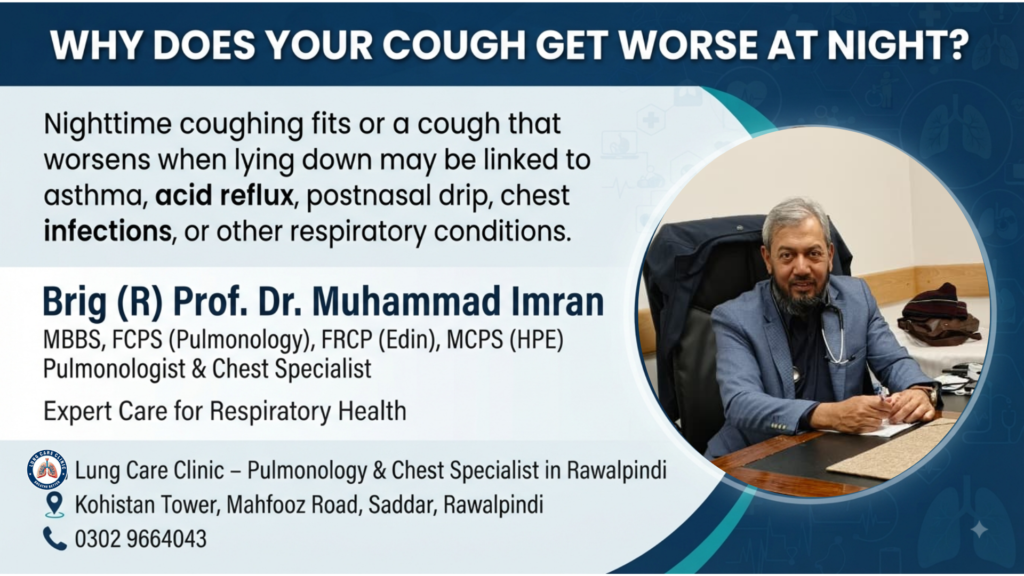
Why Does Your Cough Get Worse at Night?
A cough that becomes worse at night can make it difficult to fall asleep or stay asleep. Some people experience repeated coughing fits shortly after lying down, while others wake up several times because of a persistent cough.
The position of your body can influence how mucus and stomach contents move. In addition, airway inflammation may become more noticeable during the night. As a result, conditions such as asthma, postnasal drip, acid reflux, respiratory infections, and chronic lung disease can contribute to nighttime coughing.
A nighttime cough is a symptom rather than a diagnosis. Understanding the possible cause is important, especially when the cough continues for several weeks or is associated with other respiratory symptoms.
Why Does Lying Down Make Cough Worse?
One common reason is mucus movement. When you lie flat, mucus from the nose or airways may collect or move toward the throat. This can stimulate the cough reflex.
Lying down can also make acid reflux more likely in some people. Stomach acid or other stomach contents can move upward into the esophagus and sometimes irritate the throat or airways.
For people with certain lung conditions, lying flat may also make breathing symptoms more noticeable.
Therefore, if you find that your cough consistently becomes worse after going to bed, the timing and position of the cough can provide useful information for your doctor.
Common Causes of Nighttime Coughing
Asthma
Asthma is an important cause of nighttime coughing. Airway inflammation and narrowing can produce coughing, wheezing, chest tightness, and shortness of breath.
Some people have cough as the main symptom. Others notice symptoms after exposure to dust, allergens, cold air, or respiratory infections.
If you regularly wake up coughing, particularly with wheezing or chest tightness, asthma should be considered.
Postnasal Drip
Postnasal drip occurs when mucus from the nose or sinuses drains toward the back of the throat. This can cause throat irritation, frequent throat clearing, and coughing.
Allergies, sinus problems, and respiratory infections can increase mucus production.
The cough may become more noticeable when lying down because mucus can accumulate toward the back of the throat.
Acid Reflux and GERD
Acid reflux can contribute to nighttime coughing. When you lie down, stomach contents may move upward more easily in some people.
Reflux-related coughing may occur with heartburn, sour taste, throat irritation, hoarseness, or repeated throat clearing. However, some people experience cough without obvious heartburn.
If your cough regularly appears after meals or becomes worse when lying down, discuss the pattern with your healthcare provider.
Respiratory Infections
A common cold, bronchitis, or another respiratory infection can cause coughing that persists after other symptoms begin improving.
Mucus, airway inflammation, and throat irritation may continue for some time after an infection. Nighttime coughing can therefore occur during recovery.
However, a cough that keeps worsening, returns repeatedly, or occurs with high fever, chest pain, or significant breathing difficulty requires medical evaluation.
COPD
People with chronic obstructive pulmonary disease may experience chronic cough, mucus production, wheezing, and breathlessness.
A COPD flare-up can cause symptoms to become worse, including coughing and increased sputum production.
If you have COPD and notice a significant change in your usual cough or breathing, contact your healthcare provider for appropriate assessment.
Other Causes
Other possible causes of nighttime coughing include allergies, smoking, exposure to irritants, certain medications, chronic bronchitis, bronchiectasis, and other respiratory conditions.
Because many conditions can produce similar symptoms, persistent nighttime coughing should not be diagnosed based on symptoms alone.
What Can Help Reduce Coughing at Night?
The most effective approach is to address the underlying cause. However, some general measures may help depending on the reason for your cough.
Keep your sleeping environment free from smoke, dust, and other respiratory irritants. If allergies contribute to your symptoms, reducing exposure to known triggers may help.
If reflux appears to contribute to your cough, avoid eating large meals close to bedtime and discuss persistent symptoms with your healthcare provider.
Staying adequately hydrated may also help keep respiratory secretions less thick.
If you have a diagnosed respiratory condition, follow your prescribed treatment plan and use medications exactly as directed.
Do not start antibiotics, steroids, inhalers, or other prescription medicines without medical advice.
When Should You See a Pulmonologist?
A nighttime cough deserves professional evaluation when it persists, repeatedly interrupts sleep, or occurs with other respiratory symptoms.
Consider seeing a pulmonologist if you experience:
- A cough lasting several weeks
- Repeated nighttime coughing fits
- Wheezing
- Shortness of breath
- Persistent phlegm
- Recurrent chest infections
- Chest discomfort
- Reduced exercise tolerance
- Cough that keeps returning
A specialist can help determine whether the cough is related to asthma, COPD, infection, reflux, postnasal drip, or another condition.
What Tests May Be Needed?
The appropriate tests depend on your symptoms and medical history.
Your doctor may perform a physical examination and listen to your lungs. Depending on the findings, evaluation may include oxygen saturation measurement, spirometry, pulmonary function testing, chest X-ray, CT imaging, blood tests, or sputum examination.
If asthma is suspected, lung function testing may help assess airflow limitation. If a persistent cough requires further investigation, chest imaging may also be considered.
The goal is not simply to suppress the cough but to identify and manage the reason it is occurring.
Is a Nighttime Cough a Sign of Lung Disease?
Not necessarily. Nighttime coughing can result from relatively common problems such as a respiratory infection, allergies, postnasal drip, or acid reflux.
However, persistent or recurrent coughing can also occur with asthma, COPD, bronchiectasis, chronic bronchitis, and other lung conditions.
The duration of the cough, associated symptoms, medical history, smoking exposure, and examination findings all help determine whether further investigation is needed.
When Is a Nighttime Cough an Emergency?
Seek urgent medical attention if coughing occurs with severe or rapidly worsening breathing difficulty, blue or gray lips, confusion, fainting, severe chest pain, or an inability to speak normally because of breathlessness.
Coughing up significant amounts of blood also requires prompt medical assessment.
Do not ignore severe breathing symptoms simply because they occur at night.
Expert Respiratory Care in Rawalpindi
A cough worse at night can have many causes. Lying down may increase mucus movement or reflux, while conditions such as asthma, COPD, respiratory infections, allergies, and other airway problems can also contribute.
If nighttime coughing repeatedly disrupts your sleep or continues despite recovery from an infection, identifying the underlying cause is important. Treating the cause can be more effective than repeatedly using cough remedies without understanding why the cough keeps returning.
Brig (R) Prof. Dr. Muhammad Imran, Pulmonologist & Chest Specialist, provides expert evaluation and management of chronic cough, asthma, COPD, bronchitis, chest infections, wheezing, and other respiratory conditions at Lung Care Clinic – Pulmonology & Chest Specialist in Rawalpindi.
Kohistan Tower, Mahfooz Road, Saddar, Rawalpindi
0302 9664043
If your cough gets worse at night, especially when lying down, don’t ignore a persistent or recurring pattern. Book a consultation to discuss your symptoms and determine whether further respiratory evaluation is needed.